


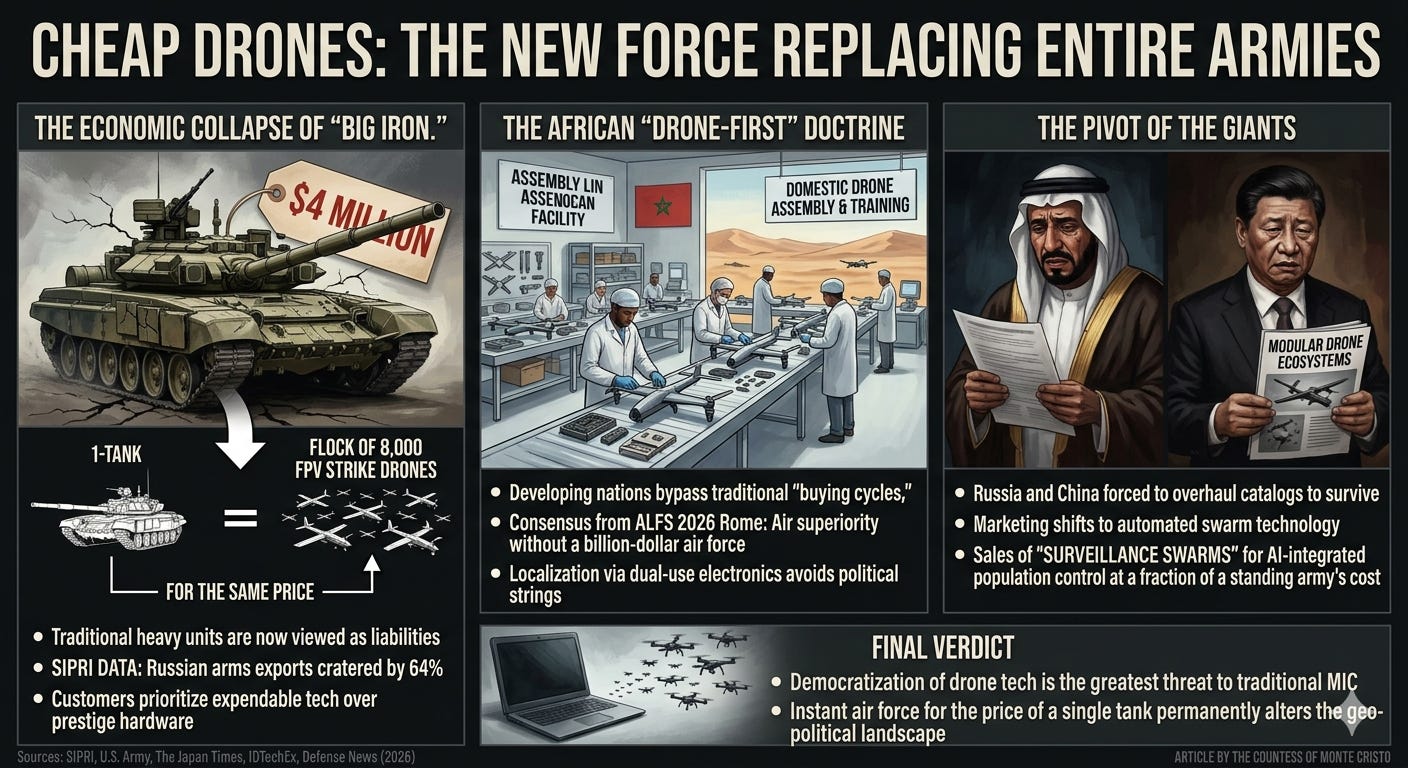
The shift toward the democratization of lethal technology is being confirmed by a massive structural change in global defense markets.
The "Ukraine Doctrine"—high-volume, low-cost, attrition-based warfare—has rendered traditional Russian and Chinese export models nearly obsolete for developing nations.
⠀
⠀
The Economic Collapse of "Big Iron"
For decades, the military-industrial complexes of Russia and China relied on selling heavy armor and manned aircraft to African and Southeast Asian nations. That era has ended.
Cost vs. Lethality: A single $4 million T-90 tank is now viewed as a liability. In the current market, that same budget can procure a fleet of 8,000 FPV strike drones.
Export Data: Recent SIPRI (Stockholm International Peace Research Institute) data shows that Russian arms exports have cratered by 64%.
⠀
This isn't just due to sanctions; it is because customers now prioritize "expendable" technology over "prestige" hardware that is easily destroyed by cheap munitions.
⠀
⠀
The African "Drone-First" Doctrine
Developing nations are bypassing the traditional "buying cycle" of Moscow and Beijing to build indigenous capabilities.
Localization: At the African Land Forces Summit (ALFS) 2026 held in Rome, the consensus was clear: air superiority no longer requires a billion-dollar air force. Commanders focused on "Innovation and Industry," specifically how to integrate dual-use technology into land forces.
Strategic Pivot: Countries like Morocco are focusing on domestic drone assembly and training.
⠀
By using dual-use electronics—often sourced through intermediaries—they are avoiding the high costs and political strings of traditional heavy armor contracts.
⠀
⠀
The Pivot of the Giants
Russia and China are being forced to completely overhaul their catalogs to survive.
The Modular Shift: Major exporters like Rosoboronexport and Chinese state-owned firms have shifted their marketing toward "modular drone ecosystems" and suicide drone technology packages.
Population Control: In regions where the primary threat is internal dissent, these nations are now selling "surveillance swarms."
⠀
These AI-integrated drones provide 24/7 monitoring at a fraction of the cost of maintaining a standing army.
⠀
⠀
Final Verdict
The democratization of drone technology is the greatest threat the traditional military-industrial complex has ever faced.
For poor countries, the ability to field an "instant air force" for the price of a single tank has permanently altered the geopolitical landscape.
⠀
⠀
Sources
SIPRI (March 2026): Trends in International Arms Transfers. (Confirmed: 64% decline in Russian exports).
U.S. Army Southern European Task Force, Africa (March 2026): African Land Forces Summit 2026 Rome Proceedings. (Confirmed: Focus on drone warfare and supply chain transformation).
The Japan Times (February 2026): China's Drone Exports to Russia via Thailand. (Confirmed: Analysis of dual-use part surges and re-export routes).
IDTechEx (2026): Drones Market 2026-2036: Technologies and Opportunities. (Confirmed: Global market valuation at approximately $69B in 2026).
Defense News (February 2026): Russia Claims $15 Billion in Arms Exports. (Confirmed: Contextualizing official Russian claims against SIPRI’s reported decline).