

The Historical Foundation: A Marriage of Convenience
To understand why Russia is currently “up for grabs,” one must look past the handshakes in Moscow and Beijing and examine the deep scars left by the Sino-Soviet Split. The relationship between Mao Zedong and Nikita Khrushchev was never one of equals; it was a volatile power struggle that nearly triggered a third world war.
The friction began in 1956 when Khrushchev denounced Stalin’s “cult of personality.” Mao took this as a personal affront and an ideological betrayal. By 1960, the Soviet Union abruptly withdrew all technical advisors from China, leaving half-finished factories and a sense of deep resentment. Mao publicly branded the Soviets as “capitulationists” after the Cuban Missile Crisis, calling them “paper tigers” who lacked the stomach for a real fight.
The tension turned kinetic in 1969 on Zhenbao Island. Chinese and Soviet troops engaged in violent ambushes that brought the two nations to the brink of nuclear war. This was the moment Mao realized he could not fight both superpowers at once, leading to his 1972 pivot toward the United States to avoid becoming a Soviet target. Today, the roles are reversed: a weakened Russia is now the one sliding into the position of a junior partner to a Chinese superpower.
The Asymmetric Reality of April 2026
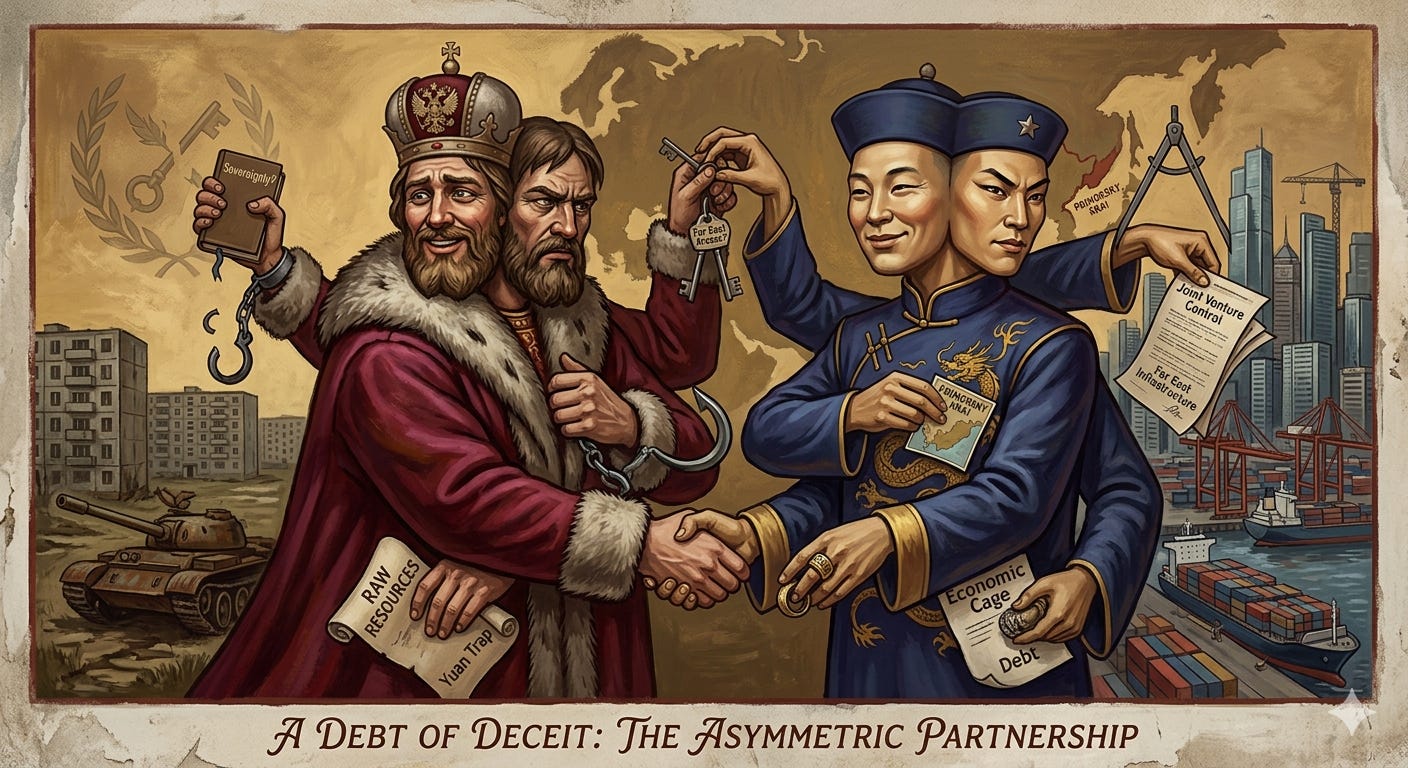
As of Monday, April 6, 2026, the geopolitical standing of Russia has reached a point of critical dependency. While Moscow celebrates record trade volumes—surpassing $244 billion—the data reveals a predatory structure. Russia has become a “resource periphery,” exporting raw energy and minerals while importing 57% of its total goods from China.
China is effectively “punishing” Russia for its lack of alternatives. By 2026, over 99% of bilateral settlements are conducted in national currencies (mostly Yuan), creating a closed loop where Russian wealth is trapped in Chinese banks. Russia cannot use this capital to buy Western tech or diversify; it can only buy what Beijing permits.
The Strategic Vacuum and the “Trojan Horse”
From a military strategist’s perspective, Russia is ripe for conquest. The Russian Far East covers nearly 7 million km², yet its population has plummeted to fewer than 8 million people. Across the border, Chinese provinces hold tens of millions who are hungry for space and resources.
This is not a conquest of tanks, but a “Trojan Horse” strategy. Under the International Advanced Development Zones (IADs) law that went into effect on January 1, 2026, China is legally immigrating into these unpopulated regions. Through simplified residency and state-backed “joint ventures,” Beijing is establishing a permanent presence inside Russian borders. By the time Moscow identifies the threat, the local infrastructure—from 5G networks to rail standards—will already be wired to Beijing.
Conclusion: Up for Grabs
Russia sits on the world’s last great cache of untapped resources—timber, fresh water, and minerals—at a time when China’s demand is at its peak. The presence of nuclear ICBMs is an irrelevant deterrent; you cannot nuke a legal immigrant population or an economic partner that owns your banking system.
Russia is currently “up for grabs” because it has abandoned the Western principles that once provided a geopolitical balance. By choosing a rigid ideology over strategic flexibility, Russia has cleared the path for its own liquidation. The “limitless friendship” is, in reality, a countdown to absorption.
Sources & Intelligence
Historical Data: Wilson Center Digital Archive – “International History Project on the Sino-Soviet Split.”
Demographic Analysis: IEEE Report (March 13, 2026) – “Russia’s Strategic Paradox: Mobilization and Depopulation in the Far East.”
Legal Framework: International Advanced Development Territories (IADTs) Law, effective January 1, 2026 – Zero-tax policies and simplified residency for pilot zones.
Trade Data: KSE Institute and OSW Reports (March 30, 2026) – Confirmed 99% currency settlement in Yuan/Ruble and $244B+ trade volume.