


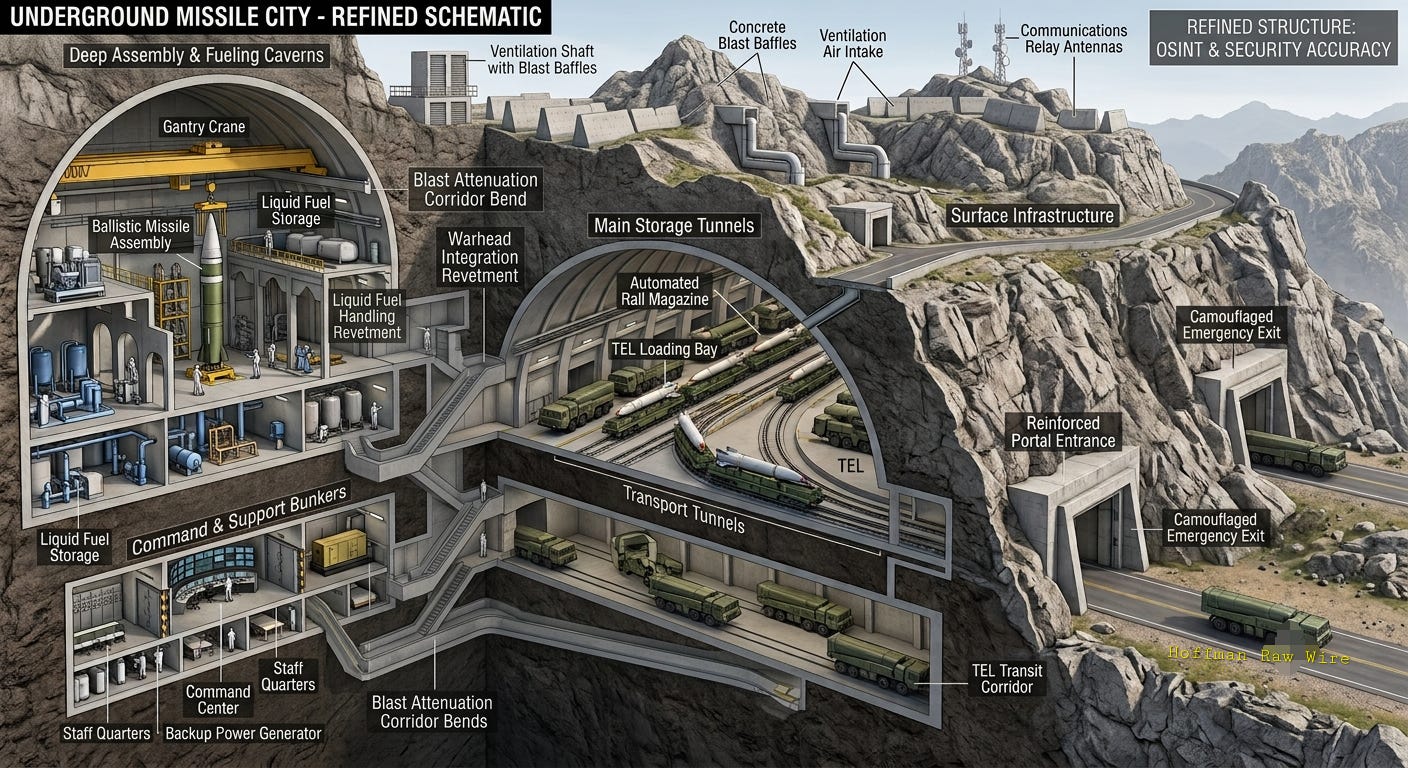
The combined lessons of the War in Ukraine and the ongoing regional confrontation in the Middle East point to an undeniable reality. While my military rank capped at First Sergeant, my relentless focus on decoding human behavior has shaped how I analyze modern warfare. Totalitarian forces rely entirely on perceived invulnerability, making the collapse of command morale the critical prerequisite to any broader military campaign.
The operational doctrine of the Islamic Revolutionary Guard Corps relies heavily on a single psychological pillar: the absolute invulnerability of its subterranean "missile cities." From the initial clashes of the Twelve-Day War through the campaign that followed, Tehran has repeatedly leveraged its deep mountain facilities as both an operational shield and an instrument of strategic leverage. The September 8–9 escalation—where the IRGC launched a barrage of 20 solid- and liquid-fueled ballistic missiles targeting U.S. forces at Muwaffaq Salti Air Base in Jordan, following U.S. strikes on five Iranian crude tankers—demonstrated once again that as long as the IRGC believes its underground command nodes, assembly halls, and launch shafts are beyond reach, its risk tolerance will remain dangerously high.
In any military engagement against a totalitarian regime, morale is not a secondary variable—it is the strategic center of gravity. Totalitarian command structures operate on projected absolute strength; once the illusion of invulnerability shatters at a core node, the psychological coherence of the entire command chain quickly fractures.
Before any strategic campaign attempts to dismantle broader Iranian state infrastructure, military planners must address this underground posture directly. My proposed operational approach bypasses traditional broad-scale attrition: neutralize the IRGC’s core sense of security first by demonstrating that its deepest rock sanctuaries can be penetrated and shattered from within.
The Lessons of Ukraine and the Permeability of Iranian Security
The War in Ukraine fundamentally redefined modern land warfare, proving to global commanders that heavy, manned ground incursions inside fortified zones are obsolete when replaced by precise unmanned systems. Field observations from the Conflict Intelligence Team and studies by the Center for Strategic and International Studies (CSIS) confirm that combining remote robotics with specialized energetic payloads allows forces to strike heavily fortified targets with pinpoint accuracy, eliminating the heavy human casualties that historically plagued subterranean warfare.
At the same time, repeated covert operations inside Iran over the past decade—documented in operational reviews by the International Institute for Strategic Studies (IISS)—have demonstrated that the regime's domestic security network is far more permeable than its propaganda claims. Intelligence assets and special operations forces have consistently punched holes through high-security perimeters. When you combine modern robotic warfare lessons from Eastern Europe with proven operational access, breaching a primary missile city transitions from theoretical doctrine to an actionable tactical plan.
Technical Execution: The Thermobaric Ground Breach
A subterranean facility is, by design, a closed system. Its greatest strength—rock overburden—is also its single greatest physical weakness. Underground galleries act as pneumatic channels. When a high-yield explosive is detonated inside an enclosed tunnel, the energy cannot escape outward into the mountain. Instead, it travels along the shafts like a piston inside a cylinder.
The operation relies on a 3.5-ton track-driven hybrid autonomous platform built with a reinforced blast shroud, solid-state LiDAR, and hardened mesh communications capable of maintaining signal control deep inside rock structures. Mounted on this chassis is a dedicated 1.5-ton thermobaric payload composed of an isopropyl nitrate fuel matrix blended with reactive micronized aluminum and magnesium powders.
First, precision strikes clear short-range air defense systems around the facility's surface portals, establishing a tight window of local air supremacy.
Second, a 30-man team of highly specialized commandos drops onto key high ground surrounding the main access road. Their sole responsibility is to neutralize perimeter guards, secure the portal entrance, and ensure the outer blast doors remain open.
Third, the heavy UGV launches down the drive-in access tunnel at speeds up to 45 kilometers per hour, breaching the outer threshold before lockdown measures can seal the interior.
Fourth, deep within the primary transport shaft, a low-velocity dispersal charge shatters the canister, atomizing 1,500 kilograms of fuel slurry into a fine aerosol cloud that rapidly expands into cross-cuts, equipment bays, and assembly halls. Moments later, a second delay fuse ignites the cloud, triggering a plasma fireball that reaches temperatures between 2,500°C and 3,000°C.
Inside an open environment, blast waves dissipate rapidly according to the inverse-square law. Inside an enclosed mountain facility, hydrodynamic modeling published in the Journal of Military Medicine and empirical testing by the U.S. Army Engineer Research and Development Center (ERDC) demonstrate that the thermobaric shock front hits tunnel walls, reflects back, and superimposes on itself, amplifying peak overpressure by 2 to 9 times compared to open-air detonations.
Furthermore, research on thermobaric explosive (TBX) compositions published by the Journal of Explosives and Propellants confirms that the post-detonation combustion of micronized aluminum extends high-temperature duration by 2 to 5 times longer than conventional TNT. This sustained combustion generates a prolonged triangular pressure pulse that channels down the tunnel network, exceeding structural failure thresholds established by the U.S. Defense Threat Reduction Agency (DTRA) for heavy reinforced concrete blast doors (overpressure exceeding 20 bar) to crush un-launched ballistic missiles, sever electrical conduits, and shear ceiling supports. The immediate consumption of all internal ambient oxygen creates a thermal vacuum and severe negative pressure drop that collapses ventilation networks and seals the main access portals with rock and debris.
Breaking IRGC Morale Before Total War
Selecting and destroying a primary missile city with a precision thermobaric breach serves as the vital prerequisite to any broader campaign against regime infrastructure.
Striking state assets like power grids or oil refineries before neutralizing the missile network leaves regional targets exposed to retaliatory barrages. By taking away the IRGC's prized underground sanctuary through this initial tactical strike, military planners achieve two critical objectives:
Psychological Collapse: Stripping the IRGC Aerospace Force of its belief in subterranean invulnerability deals a devastating blow to commander morale across all remaining installations.
Forced Asset Exposure: To maintain any launch readiness after losing a primary underground hub, the IRGC would be forced to shift remaining assets to surface positions, exposing their transport vehicles and logistics trains to real-time intelligence, surveillance, and air interdiction.
By leveraging unmanned ground robotics and thermobaric physics, forces can breach the IRGC's concrete sanctuary, collapse its primary strike capability from within, and permanently alter the strategic balance of power.
Author's Note:
Thinking back to the Vietnam-era 1st Engineer Battalion's motto—Non Gratus Anus Rodentum ("Not Worth a Rat's Ass")—it strikes me that it is time to teach the IRGC that exact same reality.