


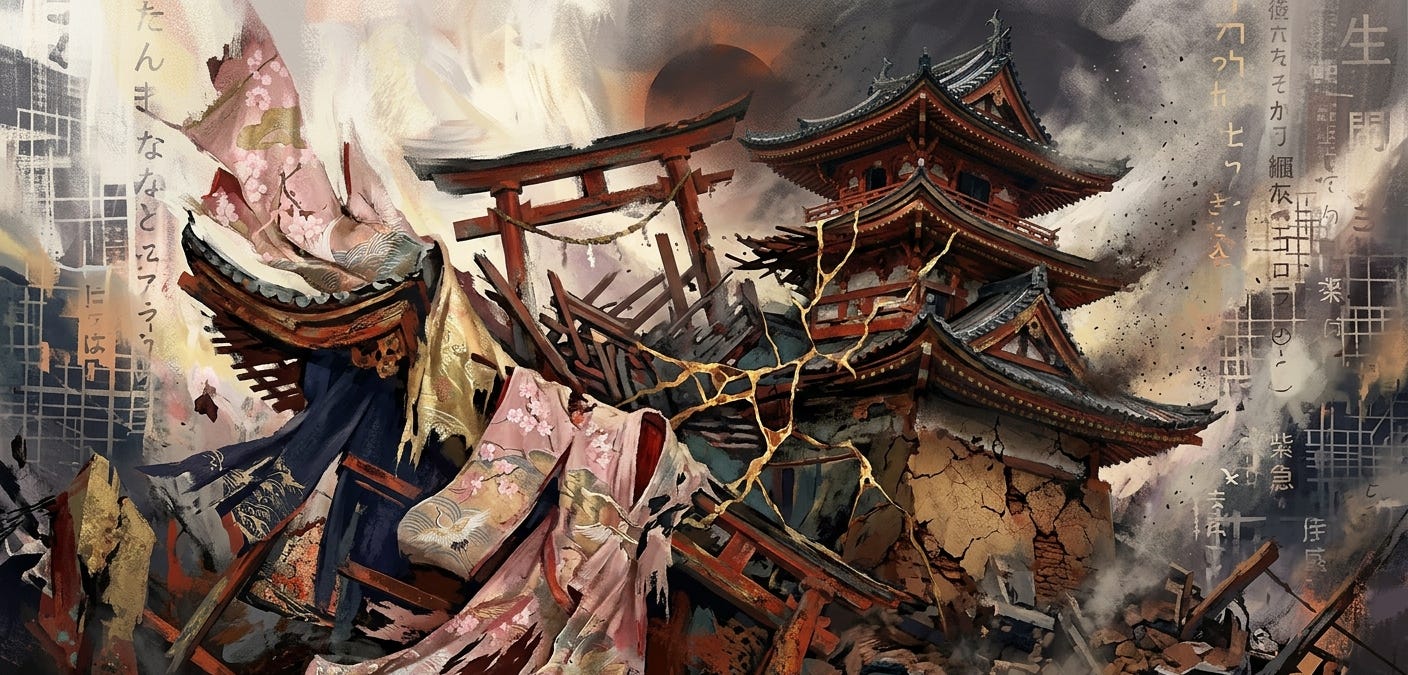
The story of modern Japan is a study of a nation simultaneously preparing for high-end kinetic conflict while fighting a silent, internal war of attrition against its own demographics.
THE GREAT REBUILD AND THE 1980S PEAK
After 1945, Japan achieved the "Economic Miracle," averaging 10% annual growth from 1955 to 1970. By the late 1980s, Japan was the world's second-largest economy, fueled by a massive asset bubble. At its peak, the land under the Tokyo Imperial Palace was famously valued more than the entire state of California.
THE LOST DECADES (1990-2026)
The bubble burst in 1991, leading to a "Lost Decade" that has effectively stretched into three. Despite massive quantitative easing, Japan has struggled with entrenched deflation and a staggering debt-to-GDP ratio, which hit 253.11% in April 2026.
DEMOGRAPHIC CAPITULATION: THE NUMBERS
The hypothesis that Japan could "disappear" is supported by the raw data. The society is effectively shrinking from the bottom up. In the year 2000, the population stood at 126.9 million; by 2026, it had plummeted to approximately 120 million, a loss of nearly 7 million citizens.
The fertility rate has hit record lows of 1.20 or lower, far below the replacement level. Meanwhile, the elderly population (65+) has surged from 17.4% in 2000 to nearly 30% in 2026. Conversely, the working-age population has dropped from 68% to roughly 58% and continues to fall.
THE FEMALE PIVOT: CAREER OVER CRADLE
Among Japanese females aged 18 to 30, a profound cultural shift has occurred. Data from 2025 and early 2026 indicates that nearly 50% of single women in this bracket express no interest in marriage. The primary driver is the "Mata-hara" (maternity harassment) culture that persists in Japanese firms. Women increasingly view marriage and children as a "career death sentence."
By prioritizing professional autonomy, these women are opting for "solo-living" consumption patterns. Surveys from the National Institute of Population and Social Security Research corroborate that for the 18-30 demographic, the perceived loss of personal freedom and the financial burden of child-rearing outweigh traditional societal expectations.
THE MALE RETREAT: ECONOMIC FRAGILITY AND APATHY
The male population aged 18 to 30 is facing a different, but equally devastating, crisis. Real-world data from the Japanese Ministry of Health and Labor shows that over 30% of young men are in "irregular" or part-time employment, earning wages that make supporting a family mathematically impossible.
This economic instability has birthed a generation of "Herbivore Men"—those who have lost interest in traditional dating or competitive career climbing. Furthermore, of the 1.46 million Hikikomori (socially withdrawn) individuals, a significant plurality are males under 30 who have completely exited the workforce and the dating pool, effectively removing themselves from the nation's reproductive and economic engine.
THE RIGID REGIMENT AND SOCIAL DECAY
Despite the decline, the work culture remains a "rigid regiment." In 2026, reports indicate a significant "motivation detachment" or "quiet quitting" among workers in their 20s and 30s. The traditional seniority system and grueling hours are failing to attract or retain a shrinking youth pool, leading to widespread social exhaustion.
A TURNING POINT: THE TAKAICHI ERA
The rise of Prime Minister Sanae Takaichi, Japan’s first female leader, marks a decisive shift toward the West. A conservative protege of Shinzo Abe, Takaichi has aggressively moved to formalize the Self-Defense Forces and strengthen ties with Washington to deter regional threats. However, this pro-Western alignment is facing its greatest test yet in the Middle East.
FRICTION IN THE GULF: THE TRUMP-JAPAN TENSION
The relationship between the Trump Administration and Tokyo has become increasingly strained over the escalating conflict in the Persian Gulf. President Trump has publicly demanded that Japan and other allies provide warships to escort tankers through the Strait of Hormuz—a vital artery for Japan, which depends on the Gulf for 95% of its oil.
Despite her landslide victory in February 2026, Takaichi has held a firm line, refusing to deploy the Japanese military to the Gulf due to constitutional and political constraints. This refusal has prompted accusations of "disloyalty" from Washington, even as the U.S. redeploys assets from the Pacific to the Arabian Sea, leaving Japan feeling increasingly exposed.
GEOPOLITICAL STANDOFF: THE CHINA-JAPAN TENSION
Relations reached a boiling point in late 2025 when PM Takaichi declared that a Chinese attack on Taiwan would constitute an "existential crisis for Japan." China has responded without firing a kinetic shot through economic warfare, restricting exports of dual-use items and rare earth materials to Japan in 2026. As of March 2026, Japan has spotted 99 Chinese vessels in its contiguous zone, with constant intrusions near the Senkaku Islands.
MILITARY RE-ARMAMENT AND ALLIANCES
To counter the demographic and regional threats, Japan has pivoted sharply. The defense budget for fiscal year 2026 reached a record $58 billion (9.04 trillion yen). Additionally, Japan is investing $640 million in unmanned defense systems—air, sea, and underwater drones—to compensate for the lack of human recruits.
HYPOTHESIS VERIFICATION
The hypothesis that China may not need to fire a shot is corroborated by the "Aging-Economic Trap." As Japan's debt climbs past $9 trillion and its tax-paying workforce shrinks, its ability to fund the very military technology needed to deter China is under extreme fiscal pressure. If the birth rate does not recover, Japan faces total capitulation as a society through internal collapse rather than external conquest.
VERIFIED SOURCES AND INTELLIGENCE
* IMF Report 2025: Predicts Japan's economic growth will slow by 0.8% annually due solely to demography.
* National Institute of Population and Social Security Research (2026): Survey on marriage attitudes among 18-30 year olds.
* Ministry of Health, Labour and Welfare (2025): Report on irregular employment trends in young males.
* International Crisis Group March 2026: "10 Conflicts to Watch," citing the China-Japan maritime spat.
* Ministry of Defense (Japan) 2026 Budget: Details the "SHIELD" littoral defense and record 12th year of spending increases.
* Keidanren (Japan Business Federation): Report on the "Motivation Gap" and the failure of traditional work culture.