

Look around at what’s happening right now in 2026. Men and women are running themselves into the dirt trying to optimize every single millimeter of their existence. Women are locked into this non-stop grind of body recomposition, targeted lifting, and macro-tracking just to build some engineered silhouette. Men are down the looksmaxxing rabbit hole—jawline routines, bone structure protocols, posture fixes, all of it. But it goes way past natural work. People are blasting steroids, SARMs, and growth compounds just to stay relevant. What used to be considered an impressive, muscular body a generation ago is treated like an insult today. People are literally destroying their health to look like comic book characters and CGI action figures.
It’s all physical. We’ve turned ourselves into walking construction sites, convinced that if we just get lean enough, big enough, or sharp enough, we’ll finally be complete.
Now look at the mental side of this exact same disease. Think back about fifteen years ago, to the early 2010s, when you couldn’t scroll for five seconds without seeing inspirational quotes plastered over t-shirts, coffee mugs, and social media feeds. People became obsessive collectors of these quotes. The mental logic was simple and flawed: the more quotes I collect, the more wisdom I hold. People hoarded lines of text like mental trophies, convinced that stacking up quotes in their head made them deeper, smarter, or more resilient.
When you strip it down, the person collecting quotes and the person stacking plates on a barbell are making the exact same motion. It’s the exact same muscle memory of the ego. One believes that adding another ten pounds of steel onto the bar will finally make them complete, while the other believes that adding another ten quotes to their memory bank will finally make them wise. It is the identical agenda executed in two different mediums—one physical, one mental—both driven by the illusion that hoarding external weight equals internal substance.
A great quote is the summary of someone else’s lifetime of pain, failure, and brutal mental work. But instead of going through the work yourself, you collect the quote as a shortcut. You want the illusion of wisdom without doing the time. A quick-fix mind to match a quick-fix body. But none of that physical sweat or collected wisdom touches what’s actually broken inside. You just end up with a tuned-up body, a head crammed with borrowed slogans, and the exact same restless, empty mind.
The punchline is that the peace you’re burning yourself out trying to build is already sitting right in front of you, completely unoptimized.
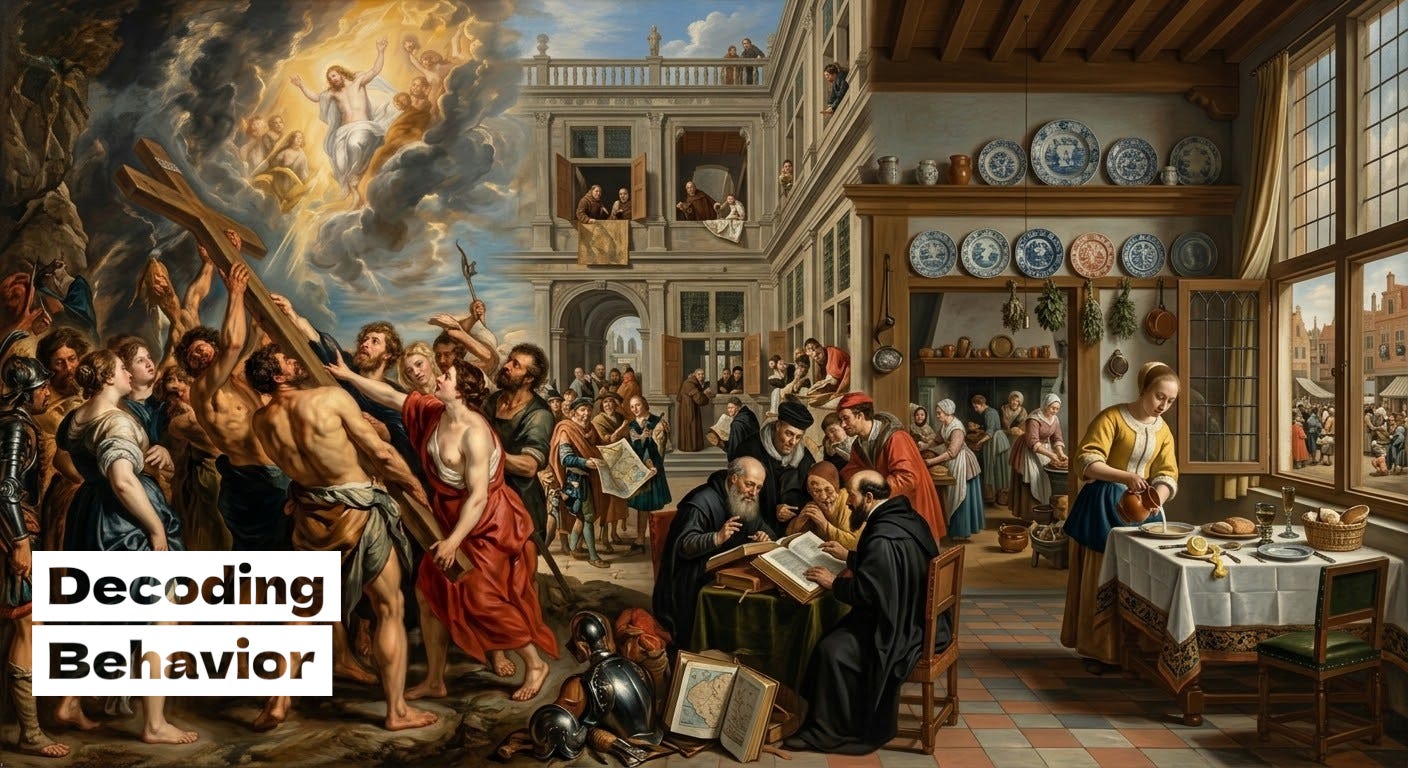
If you think this is just a modern glitch caused by smartphones and social media, think again. I’ve put together a few historical scenes for you just to show that we have been running this exact same behavioral scam on ourselves for hundreds of years. The media changes, the technology shifts, but human nature keeps falling for the very same illusion.
Step back to 17th-century Europe. If you walked into any major city back then and asked who the biggest deal was, everyone pointed to Peter Paul Rubens.
Rubens was the master of the big flex. He ran massive art factories churning out giant, dramatic canvases for kings, queens, and high priests. Goddesses on clouds, heroic battles, royal figures wrapped in silk, huge idealized bodies. Why? Because the people in power wanted to sell a dream. You walked into a palace, looked up at those massive ceilings, and felt tiny. The message was clear: real value, real beauty, real importance lives in palaces and divine realms. It lives everywhere except in your own house.
Meanwhile, over in 15th-century Japan, the spiritual world was pulling the exact same scam. The Zen establishment had turned into a country club. Monks were obsessed with wearing expensive silk robes, rubbing shoulders with politicians, and trading certificates of enlightenment like corporate promotions. They turned the search for truth into a social flex.
Then along came a rogue named Ikkyū Sōjun.
Ikkyū took one look at this performative circus, grabbed his official certificate of enlightenment, and burned it. He walked straight out of the grand temples and into the dirt. He spent his time hanging out with normal people, drinking, wandering the streets, and finding the real thing in the messy, unpolished reality of everyday life. While the big temple masters were busy posing like saints, Ikkyū pointed to the dirt and the noise of normal living and said: This is it. Truth isn’t hiding in some fancy hall or silk robe—it’s right here.
Back in Europe, in a quiet Dutch town called Delft, a couple of painters were making the exact same move. While Rubens was feeding the masses grand fantasies, Johannes Vermeer decided to just look at what was right in front of him. He didn’t care about kings or gods. He stayed in a small room, opened the window, and painted real life.
He painted a woman pouring milk from a clay jug. He painted a girl writing a letter. Down the street, Pieter de Hooch walked into the yard and painted a woman sweeping brick pavers or sitting on a patio with a child. They painted the real person next door—unpolished, normal, living a normal life in a normal body.
And look at what they did with the light. No dramatic spotlights, no fake drama. Just soft, normal morning daylight coming through a window. By simply paying attention to the everyday moment, they showed that the moment was already complete. The milkmaid wasn’t trying to look like a goddess or hoard quotes about hard work. She didn’t need a palace. The quiet reality of her sitting in that room, bathed in simple light, was already perfect.
This is what a real Zen teacher is actually trying to get you to see about human behavior.
The gym obsession, the steroid cycles, the quote hoarding, the grand art, the fancy titles—it’s all the exact same hamster wheel. We are constantly running away from right now, chasing some engineered fantasy to cover up the feeling that we aren’t enough. We tell ourselves we need to rebuild our bodies, stack up mental shortcuts, or become someone huge before we matter.
When you stop running, you realize the fulfillment you’ve been chasing has been sitting right next to you the entire time. It’s in your garden. It’s in the morning light hitting your living room floor. It’s in the normal, slightly imperfect person sitting across from you.
Perfection isn’t something you build in a gym, quote from a book, or buy in a store. It’s just opening your eyes to the life you’re already living.