


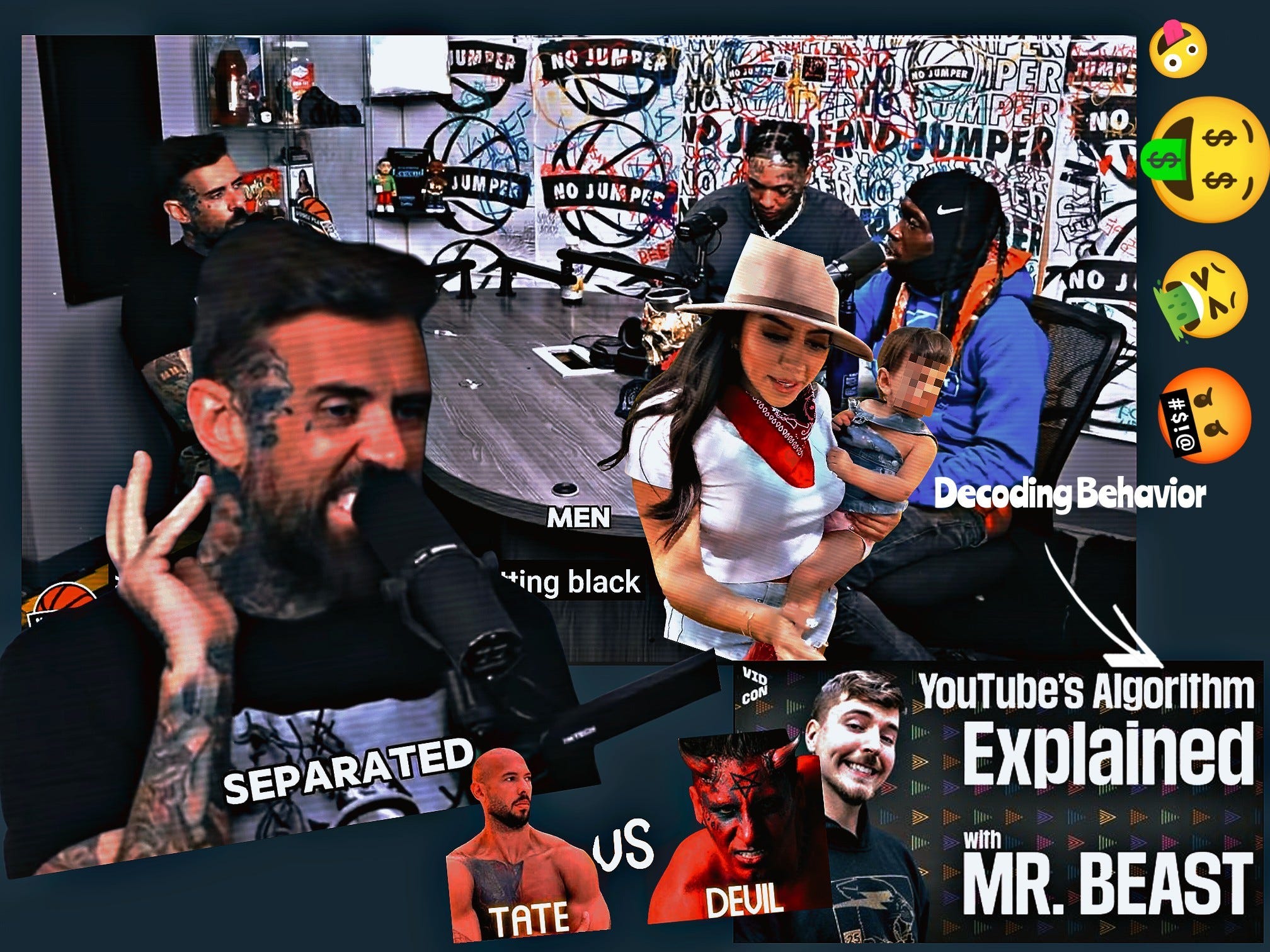
Let me tell you a story about modern ingenuity, or rather, the complete absence of it.
Once upon a time, a man named Adam decided that the fastest route to the top of the digital food chain was to take an exceptionally simple human kink—one almost entirely normalized across Western society—and turn it into a corporate empire. It was brilliant in its sheer, unvarnished laziness. It wasn't some radical cultural revelation; it was just a base instinct packaged for mass consumption. But as normalized as it might be in private bedrooms, you cannot take it to the bank to purchase real, lasting substance, no matter how much digital noise you generate around it.
"Never be afraid to state the obvious." This isn't a piece of gentle wisdom—it's a direct charge against the audience watching the screen. The obvious truth was staring every single viewer right in the face from the very first upload: you cannot broadcast every intimacy, every family drama, and every corner of your domestic life for internet points without eventually receiving the invoice. At least half the consumers cheering on this circus knew precisely where the train was heading. They just chose to play blind while waiting for the inevitable derailment.
For a long time, the machine hummed along perfectly. The math was staggering. At his peak, Adam stood in front of microphones bragging about bringing in a million dollars a month on No Jumper alone, while Plug Talk hauled in comparable sums. He was paying for lavish weddings in Italy, proposing to his partner, Lena, with expensive rings, and rationalizing the entire arrangement like a clinical test subject. He compared non-monogamy to taking suboxone to quit heroin—a controlled substance to keep the baseline steady so you do not go out and rob the local Walmart.
The architect thought he was the grand director of the theater. The rules were simple, rigid, and entirely one-sided: threesomes with adult stars were fine, but male collaborators for his wife were strictly off-limits because he was "too sensitive, jealous, and emotional."
Then came the inevitable escalation that every shock-artist faces when the algorithm demands fresh blood. To keep the view counts inflated and the million-dollar months rolling, the boundaries were pushed. Enter Jason Love. A single shoot turned into a million-dollar OnlyFans month, which turned into a surreal post-mortem interview where the husband sat calmly across from another man, asking him to rate his wife's performance on a scale of one to ten.
And right there in that room, the bright red stop sign flashed for anyone with a shred of self-awareness left. When Jason handed down his verdict, stating it was a nine out of ten because "you got to leave room for something that could possibly top the next one," Lena didn't hesitate. She looked right back at him and said, "Okay, yeah, I'll take a nine then, that's fair." She accepted the score without missing a beat while her husband sat inches away recording the whole exchange. It was the exact moment the illusion should have shattered. Any functional person would have recognized that the joke was no longer a joke, that the boundaries had not just blurred—they had been completely erased on camera for a quick rating. But instead of seeing the glaring warning sign right in front of his face, Adam just nodded along, completely numb to the reality unfolding in his own studio.
From there, the theatrical performance devolved into a full-blown humiliation ritual. There were staged Internet feuds, viral boxing matches where Adam got knocked out in 73 seconds by the very man who bedded his wife, and public streams where he offered a million dollars to rival influencers just to abandon their partners and join his roster. He even organized a bachelor-style reality show, For the Love of Lena, where the grand prize was intimate time with his wife.
And here is where the tragedy of the story actually lives. Somewhere between the endless livestreams and the desperate escalation, a fatal slip occurred: he mistook what he was doing on camera 24/7 for actual reality and true, unshakable substance. This was never just about monetization or chasing a paycheck; he genuinely convinced himself that the performative sludge captured by a lens constituted a real life, a real marriage, and a real purpose. He traded the raw, unedited truth of being a human being for the illusion that constant exposure holds inherent weight, completely forgetting that an algorithm does not construct reality—it only burns through it.
He lacked the basic cognitive capacity to understand how human energy actually moves. Being an extrovert or an introvert is not a moral identity or a superpower; it is just energy pulling in one direction or the other. When you hurl all your energy outward into the cloud, eventually the cloud gets bigger than you are and starts pushing back. By the time he realized he was getting crushed under the weight of his own stunt, he tried to tap the brakes.
Suddenly, the grand mastermind discovered he was never the player at all. He was just a pawn in a game he was entirely unprepared to understand. The business started hemorrhaging cash, No Jumper went public with claims of going broke, and the bravado crumbled on camera. Instead of managing an empire, he sat on podcasts admitting his cash flow was running dry while guests openly mocked his domestic situation.
When Lena went on a live stream and threw her wedding ring across the floor to generate a viral moment, the performative world he mistook for substance finally shattered. He admitted on air that the ring represented a time when money was hard to come by, and watching it tossed for cheap clicks actually stung. Shortly after, the public separation became official.
In a bitter twist of comedy, the man who spent a decade streaming every private corner of his life sat in an empty room complaining that his wife left him because he was too lazy to do basic household chores, pick up their daughter from private school, or participate in family life. Even in separation, he immediately ran to his podcast microphones to talk about playing the field, only to get scolded by his ex-partner for appearing too gleeful on camera—before admitting he has no real-life skills and does not even know how to date as an adult. He mistook the feed for reality and substance, only to discover that when the cameras turn off, you are left alone in an empty house with zero actual foundation beneath your feet.
The day the industry declared that MrBeast had cracked the algorithm was actually the day the algorithm cracked us. It triggered a digital gold rush, drawing millions to flock toward the ultimate dream of algorithmic mastery, convinced that living 24/7 in front of a camera was the highest form of human achievement. But just like the 1849 California Gold Rush, the gold field does not enrich the prospectors; it exhausts them. Everyone rushes in, throws their sanity, their relationships, and their privacy into the pit, mistaking the noise of the saloon for a real life—only to end up passed out drunk on the floor after spending everything they worked for on a completely fake reality.
This whole ecosystem of hyper-optimized content is a bizarre, quirky fantasy world where people act out whatever absurd impulse pops into their heads, convinced there will never be recourse or consequences. It is the exact same hollow playbook used by Andrew Tate, who chose a slightly different flavor of zero-substance posturing wrapped in the grand facade of unfiltered male wisdom.
Both of these men started with the most obvious, base-level instinct they could find and tried to dress it up as direct, no-nonsense reality. And both ended up in the exact same trap. They were recorded, spied on, picked apart for clips, snitched on, and chewed up by the very platforms they thought they controlled, all to generate engagement for someone else. Two reckless, makeshift shepherds who led their devoted flock on a long, noisy journey through the wilderness, only to arrive right back where they started: staring blankly at the obvious.