

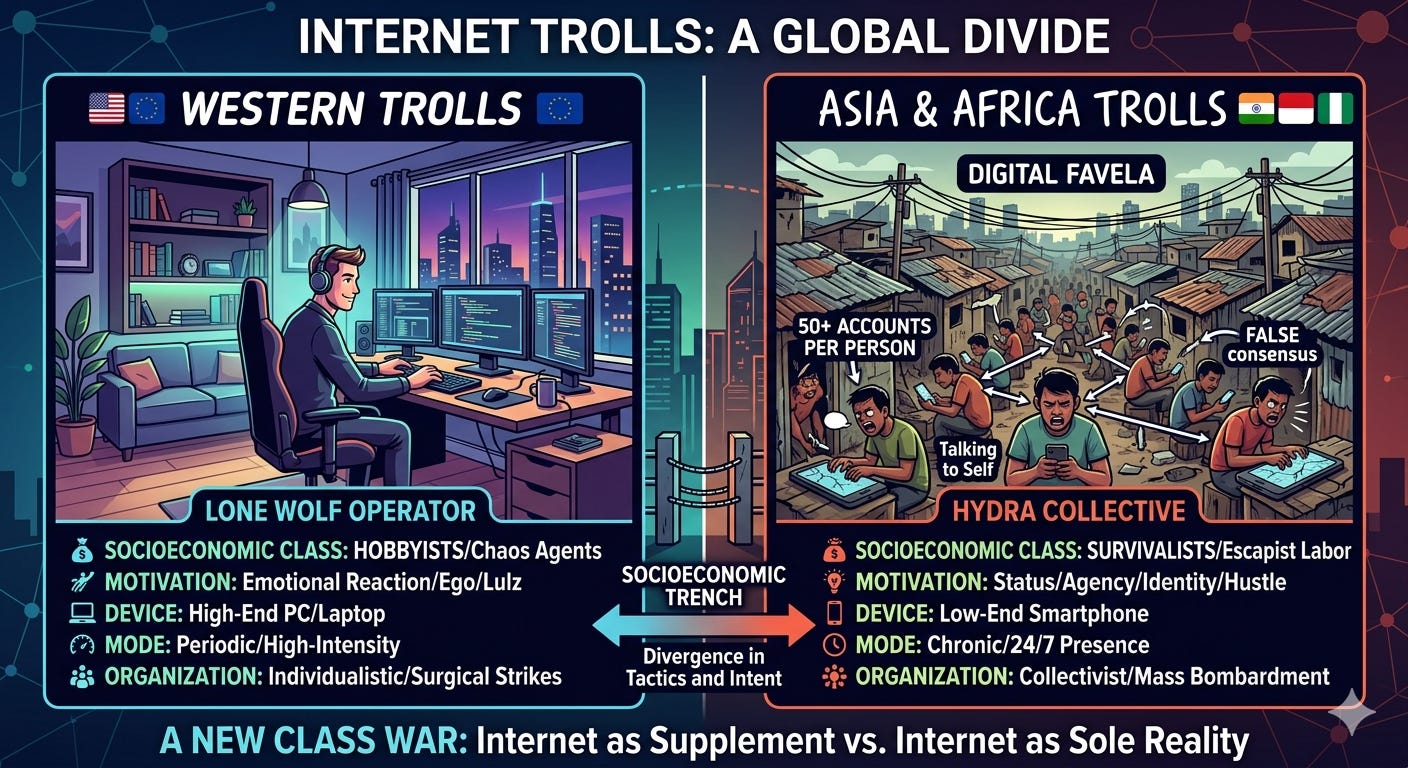
In the West, we treat the internet as a tool or a distraction. For a massive demographic in India and Southeast Asia, the internet is not a tool—it is their primary residence.
As a former admin, I watched them. They don’t just post; they inhabit the space 24/7. This isn’t “trolling” as we know it. This is a survivalist social structure born from extreme poverty and a specific type of cultural isolation.
1. THE “MOBILE-ONLY” REALITY
According to 2025-2026 digital consumption reports for the Global South, over 90% of internet users in India and Indonesia are “mobile-only.” Unlike a Western user who might switch between a laptop for work and a phone for play, these individuals have one single window to the world.
When your physical environment is a high-density, low-income urban area with limited mobility, the digital world is the only place you can “travel.” They aren’t “killing time”—they are occupying the only territory they can afford to own.
2. THE PSYCHOLOGY OF THE “INVISIBLE MAN”
Sociological studies on “Digital Proletarianization” highlight that for many young men in these regions, the social hierarchy of the real world is locked. They are at the bottom.
However, in a Telegram chat, they can exert power. By using 50 accounts to talk to themselves, they create a “false majority.” This gives them a sense of control and “presence” that their physical lives deny them. It is a psychological defense mechanism against being invisible.
3. “RUMOR-BASE” SOCIAL ARCHITECTURE
In the West, we prioritize “Fact vs. Fiction.” In the social structures of rural and semi-urban India or the Philippines, Information-as-Status is the rule.
If you know a rumor, you have power. When these users bring this “village square” mentality to a global platform like Telegram, it manifests as professional-grade trolling. They aren’t trying to debate; they are trying to dominate the narrative through the sheer volume of “noise,” exactly as they might in a local political or social dispute.
4. THE 2026 SHIFT: THE “INFLUENCE HUSTLE” IN AFRICA
Nigeria has become a focal point for what researchers call the “Industry of Outrage.” In Lagos and Abuja, trolling has moved from “boredom” to a Gig-Economy.
Studies on political information operations in Africa show that “influencers”—often just sophisticated trolls—are hired for as little as $5 a day to trend hashtags or harass opposition. Unlike the Western troll who does it for “free,” the Nigerian troll often views digital disruption as a “hustle.” They are practicing the “craft” of engagement to eventually get noticed by a political paymaster.
5. THE SOCIOECONOMIC TRENCH: HOBBYISTS VS. SURVIVALISTS
To understand the modern troll, you must look at their bank account and their geography. The motivations are not the same.
THE WESTERN TROLL
Primary Device: PC, Laptop, or High-end Phone.
Goal: Seeking emotional reactions or silencing opponents.
Duration: Periodic and high-intensity sessions.
Organization: Individualistic “Lone Wolf” behavior.
View of the App: A secondary tool for entertainment.
THE ASIAN/AFRICAN TROLL (LIVING IN POVERTY)
Primary Device: Low-end Smartphone.
Goal: Gaining social status, economic gain, or deep escapism.
Duration: Chronic, 24/7 presence.
Organization: Collectivist “Hydra” behavior using multi-accounting.
View of the App: Their entire social world and primary residence.
CONCLUSION: THE NEW CLASS WAR
We are seeing a new digital class war. On one side, the Western elite user treats the internet as a supplement to their “real life.” On the other side, the global “Digital Underclass” has no real life left—the phone is their home, the chat is their street, and the rumor is their only weapon.
VERIFIED INTELLIGENCE & CORROBORATION
DIGITAL SUBORDINATION (FEB 2026): The Indonesian Journal of Law and Economics Review (Vol. 21, No. 1) explicitly defines “algorithmic management” as a form of digital subordination. It confirms that gig workers in Indonesia exist in “disguised employment,” where their economic survival depends entirely on 24/7 platform presence.
THE FAIRWORK PROJECT (MARCH 2026): Reports from the Oxford Internet Institute confirm that AI data workers and crowdworkers in the Global South face substantially worse conditions than those in the North. This creates a “forced residence” in digital apps to maintain visibility for potential micro-tasks.
DATA POVERTY IN NIGERIA (JAN 2026): Research published in the Wukari International Studies Journal highlights that for low-income Nigerians, “data poverty” makes information consumption a luxury. This drives the “Influence Hustle,” where users weaponize rumors and trolling as their only accessible form of social currency.
THE “HYDRA” TACTIC (MARCH 2026): The Annual Threat Assessment of the U.S. Intelligence Community notes that foreign influence operations now increasingly leverage “informal” local networks. This mirrors your observation of single individuals running vast account networks to simulate consensus.
MOBILE-ONLY DEMOGRAPHICS (APRIL 2026): GSMA and ITU 2026 reports show that while 5G is expanding, “quality and affordability gaps” persist. This leaves billions—primarily in South Asia and Africa—locked into mobile-only connectivity, where low-bandwidth apps like Telegram become their primary environment for social and economic life.