

The global landscape in 2026 is defined by a massive collision between high-tech advancement and raw energy reality. As we push into the era of utility-scale quantum computing and massive AI "factories," the world's power grids are being forced into a radical transformation.
The Quantum Catalyst
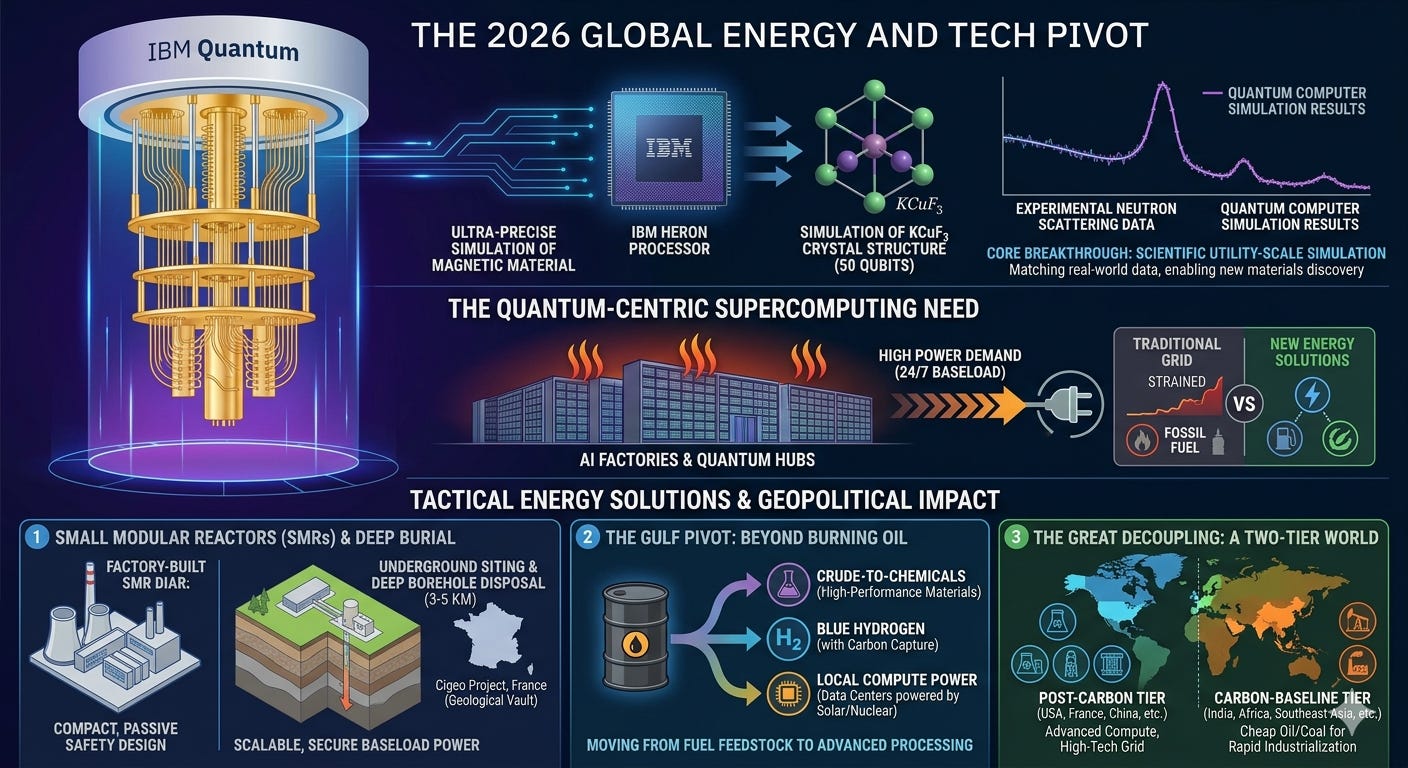
In March 2026, IBM achieved a watershed moment in materials science. Using a 50-qubit Heron processor, researchers successfully conducted a precise simulation of the magnetic material KCuF_3. For the first time, quantum hardware produced results that perfectly matched real-world laboratory data, proving that quantum computers are no longer experimental toys but essential scientific tools. This breakthrough opens the door to discovering new superconductors and high-efficiency batteries, but it comes with a steep price: an insatiable demand for energy.
The Infrastructure Crisis
Traditional data centers are evolving into "AI Factories." These facilities, along with the cryogenic cooling systems required for quantum processors, demand 24/7 baseload power. The intermittent nature of solar and wind, combined with the phase-out of coal and gas in the West, has created a critical energy gap. In response, the industry is pivoting toward nuclear energy as the only viable, carbon-free solution capable of sustaining this computational load.
Tactical Nuclear: SMRs and Subterranean Solutions
The solution to the public's historical fear of nuclear power lies in two strategic shifts:
Small Modular Reactors (SMRs): These factory-built, plug-and-play reactors can be deployed directly next to data centers. Their compact design and passive safety systems make them physically incapable of traditional meltdowns.
Underground Siting and Deep Burial: To solve security and waste concerns, there is a push for subterranean reactors and "Deep Borehole Disposal." By placing reactors and waste in geological vaults 3 to 5 kilometers underground—similar to France’s Cigeo project—the material is isolated from the biosphere and protected from surface threats.
The Gulf Pivot: From Fuel to Feedstock
As the West moves toward nuclear sovereignty, the Gulf countries are executing a strategic survival plan. Recognizing that the era of burning oil is ending, they are shifting from being "gas stations" to "material labs."
Crude-to-Chemicals (C2C): Turning raw oil into high-performance polymers and carbon fiber for advanced manufacturing.
Blue Hydrogen: Leveraging existing gas infrastructure to create hydrogen while sequestering carbon back into depleted wells.
Exporting Intelligence: Building massive, locally powered data centers to sell "compute power" rather than raw barrels of oil.
The Global Split
Despite the high-tech shift in the West, the world is not moving in unison. A "Great Decoupling" is occurring, creating a two-tier global energy market:
The Post-Carbon Tier: Western nations and advanced economies (e.g., USA, France, China) focusing on nuclear, SMRs, and quantum-centric grids.
The Carbon-Baseline Tier: Developing regions in Africa, Southeast Asia, and India. For these nations, cheap, discarded oil and coal remain the only viable way to sustain rapid industrialization and basic survival for growing populations.