


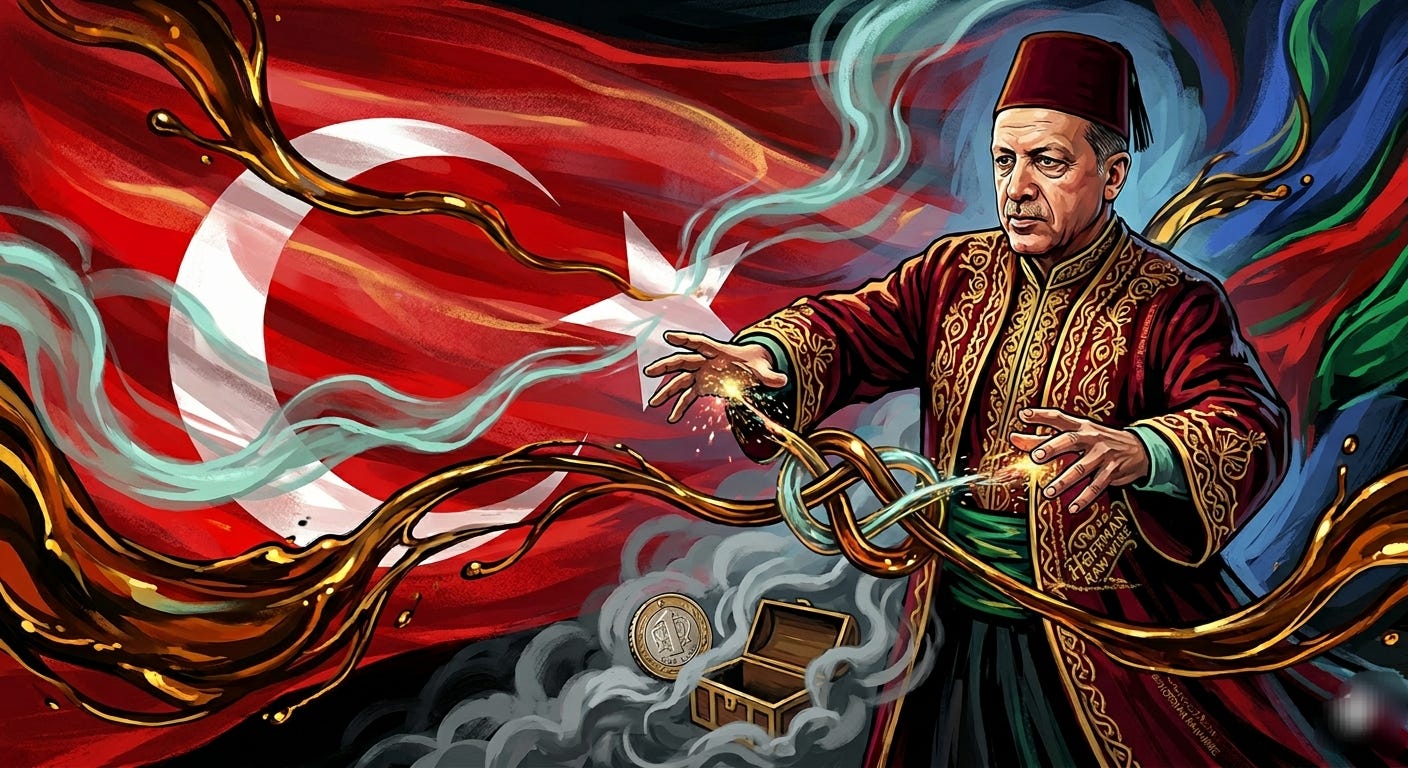
President Erdoğan of Turkey has mastered the art of the geopolitical tantrum. Daily declarations of hostility against regional players are currently the primary export of Ankara, serving as a convenient distraction from the fact that the Turkish economy is effectively running on fumes, prayer, and the desperate liquidation of state assets. While the noise level in Turkey has reached a fever pitch, the financial reality behind the rhetoric suggests that Erdoğan is not preparing for a crusade—he is simply trying to survive a bankruptcy of his own making.
A Decade of Self-Inflicted Decay
To understand Turkey's current vulnerability, one must realize that the house was structurally compromised long before the IRGC and Israel traded blows. For over fifteen years, Ankara pursued an economic policy that defied gravity: keeping interest rates artificially low to fuel debt-driven real estate booms while treating inflation as a minor detail.
The result was predictable. By the time inflation inevitably spiraled completely out of control—peaking at an astonishing 85% in late 2022—the state response was to burn through assets rather than fix the underlying policy. To prevent a total currency freefall, the Central Bank systematically drained its foreign currency reserves, effectively running on heavily negative net reserves by borrowing from domestic banks and Gulf states just to keep the lights on. The current regional instability did not create this crisis; it merely stripped away the remaining paint from a vehicle that has been broken since 2011.
The latest IMF Article IV consultations for 2026 highlight the persistence of this decay, projecting that consumer price inflation will remain stubbornly anchored near 28.6% for the remainder of the year. This long-term failure undercuts any illusions of systemic recovery, exposing a deliberate political choice to prioritize regional posturing over institutional economic survival.
The Fiscal Reality: A House of Cards
When the Middle East conflict escalated, the international markets responded exactly as one would expect when an already fragile economy faces an external shock. The Lira was instantly hit with intense speculative pressure as crude oil prices surged, directly threatening Turkey's inflation targets and widening its current account deficit.
To prevent the currency from experiencing an immediate collapse, the Central Bank of the Republic of Turkey was forced into a desperate defensive play, burning through a staggering $12 billion in foreign currency reserves in a single week through state-owned lenders just to stabilize the exchange rate.
When paper reserves proved entirely insufficient to stop the bleeding, the world’s most aggressive gold hoarder underwent a sudden, frantic 180-degree turn. In a desperate two-week panic following the outbreak of the war, Ankara quietly mobilized, sold, and swapped roughly 60 tons of its gold stockpile—worth over $8 billion—just to generate emergency cash and keep the Lira from cratering into oblivion. This represents the single largest weekly drawdown of Turkish gold in nearly seven years.
But the fire sale didn't stop at the bullion. Before touching the gold, Ankara systematically hollowed out its portfolio of foreign liquid assets, aggressively dumping its holdings of U.S. Treasury bonds. In a matter of weeks, Turkey's U.S. Treasury stash collapsed by roughly 90%, skyrocketing from $15.7 billion down to a meager $1.8 billion. To fund day-to-day operations, the treasury is now forced to sell domestic short-term government bonds at deeply depressed prices, offering desperate, sky-high yields of over 42% just to entice international buyers into taking a gamble on Turkish debt.
As of mid-2026, gross foreign exchange reserves have eroded to roughly $53.1 billion. Crucially, this drops Turkey’s liquidity buffer to a precarious 1.6 months of import cover—hovering just fractions above its historical all-time floor of 1.3 months. In stark financial terms, Turkey is living paycheck to paycheck, and the hard currency needed to buy its way out of trouble is simply gone.
The Pipeline Fantasy
Erdoğan’s hostility toward Israel is not merely ideological; it is a direct result of being cut out of the map. Ankara desperately wanted to be the primary energy hub for the Eastern Mediterranean, but Jerusalem and its regional partners—Greece, Cyprus, and the United States—formed an energy center that bypassed Turkey entirely.
Having lost that prize, Erdoğan has pivoted to a new strategy: securing a transit corridor for oil and gas through Syria. This explains his deep military footprint in the north following the collapse of the Assad regime. He is trying to force a "Development Road" into existence to siphon regional energy and collect transit fees. His daily escalations against Israel are a smokescreen designed to hide this pivot while positioning himself as a populist champion. It is a classic move: when the economy fails at home, manufacture an enemy abroad.
The Math of Impossible War
Can Turkey actually afford to fight a high-intensity conflict? The numbers provide a brutal answer.
Turkey’s total central government defense and security budget for the 2026 fiscal year has been artificially inflated to 2.15 trillion Lira (roughly $27.3 billion). However, this aggressive prioritization comes at a devastating internal cost. Central government expenditure reports reveal that feeding this defense buffer has caused the broader domestic budget deficit to rupture, with the monthly cash balance deficit expanding past 252 billion Lira in May 2026 alone.
In contrast, the direct, short-term frontline costs of the specific military campaign against Iran incurred an additional cost of $12 billion for the state up until a cease-fire took effect on April 8. When looking at the total cumulative multi-front economic burden born by Israel since October 2023, the figure stands at a staggering $138 billion.
If Turkey were to engage in a high-intensity conflict, it would consume its entire annual defense budget in roughly three weeks. Given Turkey’s "BB-" credit rating, it cannot borrow the billions required to sustain a war effort without triggering hyperinflation and an immediate sovereign default. Erdoğan knows this. He is not a general preparing for the field; he is a politician performing for the cameras.
The Nuclear Reality and the American Choice
The most striking part of Erdoğan’s hypocrisy is his dependence on the United States. His military infrastructure—his air force, his intelligence capabilities, and his hardware—is heavily reliant on American technology and NATO integration.
Erdoğan maintains the illusion that he can leverage this position, but he is playing a losing game. Washington remains deeply pragmatic. If forced to choose between a bankrupt partner screaming on international platforms and a nuclear-armed ally that holds a core position in the regional security architecture, the United States will choose the latter every single time. They will not say it out loud—that would ruin the diplomatic theater—but the choice is already made.
Turkey is not going to war. It cannot afford to buy the ammunition, let alone sustain the mobilization. Erdoğan is simply shouting at the horizon to distract his citizens from the empty shelves and the collapsing currency at home. He is betting that if he yells loud enough, nobody will notice the state coffers are empty.