


Most issues of Hoffman Raw Wire examine the forces that shape nations, economies, institutions, and conflicts. At their core, however, those subjects are all studies of human behavior.
This essay is no different.
Unlike my usual work, what follows is a true story from my own life. It is a story about family, obligation, forgiveness, self-deception, and the uncomfortable truths that sometimes wait decades to reveal themselves. The scale is smaller than the subjects I usually write about, but the theme is the same: human beings and the choices they make.
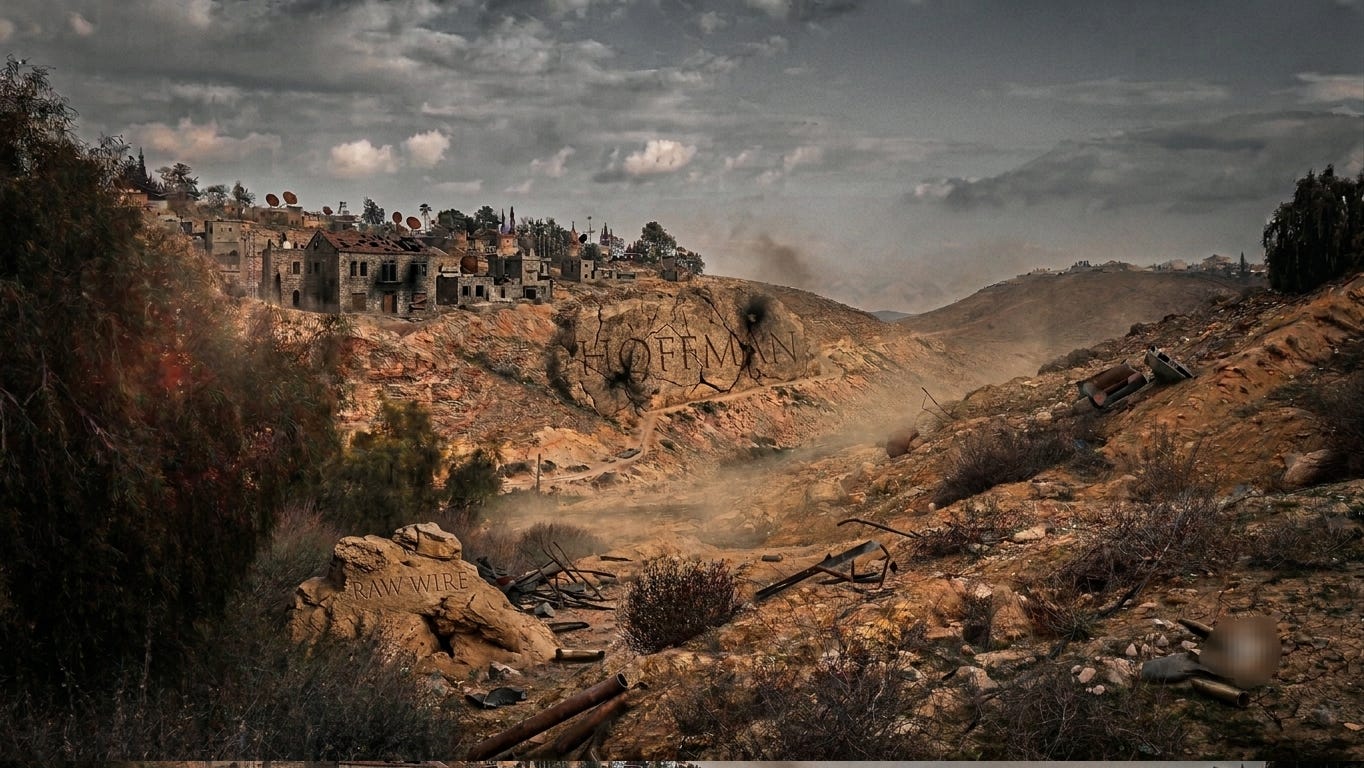
The desert in the shadow of the rain does not wear the static, golden monotony of the Sahara. It is a temperamental canvas. In the spring, it counterfeits a lush green; in the autumn, it bruises into a deep, sullen purple. It is a landscape that masterfully pretends to be something it is not, which, if you think about it, is a very human trait.
In a neat, almost gated neighborhood flanking this kaleidoscopic wasteland, Michael Hoffman grew up under the impression that the world was a straightforward machine. His family legacy was etched into the very foundations of the soil. His adoptive grandparents had been the foundational builders of this small town, carving a community out of nothing. Yet, for the last hundred years, the family lineage had been fundamentally shaped by hardship, successive wars, and deep-seated trauma. Michael’s grandfather had fought in a war, a grueling experience that passed its grim shadow down to the next generation. His adoptive father had fought in a war as well, returning to become a police officer—a towering, formidable man whom everyone in the town was deeply afraid of. He was a man who saw the world strictly in legal codes, rigid discipline, and chalk lines, while his adoptive mother kept a spotless, tightly controlled house.
When Michael returned from his own military service, he possessed the same disciplined mind, a steady hand, and the naive confidence of a young man who believed that every broken mechanism could be repaired if one simply applied the correct manual.
Naturally, he set out to find the authors of his existence.
The discovery was a masterclass in irony. His biological parents, a couple named Vance, did not reside in some distant metropolis. They lived five miles away, in a sagging Section 8 bungalow supported entirely by the state and an unwavering dedication to indolence. More curious still, they were still together—a rare phenomenon in the archives of abandonment—and Michael was the oldest of seven children. He was the solitary volume they had edited out of the family library; the other six had been retained to maximize the monthly government stipends.
When the social worker ushered Michael into the meeting room, the script called for tears, recriminations, and perhaps a dramatic demand for explanations. Instead, Michael looked at the two weathered strangers, felt the heavy, useless weight of resentment, and simply offered them a cigarette. They went out to the alley and smoked in total silence.
It was a beautiful, instantaneous gesture of absolution, but it contained a hidden danger. By forgiving them in a heartbeat, Michael instantly took away the burden of their guilt. This immediate pass gave his biological mother the freedom to return directly to her true character and her worst faults, completely bypassing any need for self-reflection. It highlights a central moral: if you forgive someone too quickly, you deny them the time and the friction required to actually reflect on what they have done.
Though Michael learned of the six siblings who had remained in the household, he never actually met his direct brothers and sisters. This complete separation was maintained by an invisible but absolute socioeconomic wall. Michael lived, worked, and engaged entirely within a stable, middle-class world. His biological siblings, on the other hand, were trapped in deep, systemic poverty. Like many who are deeply poor, they stayed firmly within their own enclaves, keeping to themselves and viewing the outside world with suspicion. The two parties saw themselves as entirely different kinds of people, ensuring they remained total strangers despite the short distance between them. Over the years, Michael only crossed paths with some of his biological cousins. Even then, the encounters were hollow; the cousins remained entirely unaware of the blood relation, leaving Michael to navigate the periphery of his own history alone.
But the Vance household was not governed by the laws of logic. It was a matriarchy of misery. The biological mother was an artist of unemployment, a woman who used her lack of education as a shield and her family as currency to procure gin and cigarettes. Michael tried daily to reach her. She was funny, engaging, and sharper than she let on—until the afternoon Michael, driving to his security job, listened to her habitual complaints about poverty.
“What’s the problem?” Michael asked lightheartedly. “Just get a job.”
“Doing what?” she sniffed. “Hard labor? Retail?”
“Well,” Michael joked, “if all else fails, you can always work the streets.”
It was a harmless bit of banter, but in the Vance household, a joke was ammunition. Within an hour, the mother had mobilized her eldest daughter to spread the word that Michael was a monster.
The green valley of Michael’s new family turned instantly to dust. Yet, Michael persisted. For nearly twenty years, he functioned as the family’s uninvited caretaker, blaming himself for every friction.
There was Jimmy, a younger brother he knew only through the fragmented updates of others—a troubled soul whose mind eventually fractured into bipolar disorder. When Jimmy ended his own life, Michael received the news via a frantic phone call from a niece. His biological parents hadn’t bothered to dial his number. At the funeral, Michael thought, Here is the tragedy that will bind us. He was mistaken. They merely used the grief to build higher walls.
Years passed. Another brother sank into deep, destructive alcoholism. Michael, who had conquered his own three-year demon with narcotics, recognized the signs with terrifying clarity. He went to the father, pleading with them to intervene.
“He needs twenty-four-hour protection,” Michael warned. “He needs to leave his drinking buddies.”
The family nodded and did precisely nothing. They preferred to leave the matter to God or time, both of whom were notoriously busy elsewhere.
The final movement of the sonata began with a phone call from the alcoholic brother. “Dad has cancer,” he said. “If you want to do a good deed, go see him.”
Michael found his biological father in a cramped, unfamiliar room, having been evicted from his previous home because his grandchildren had systematically destroyed the property. The old man sat there, complaining about the high cost of a failed rehab stint for the alcoholic son, completely blind to the fact that the disaster had been predicted years before.
As Michael sat by the bedside, looking at the dying man, the great, colorful illusion of the desert finally vanished.
He realized the grand joke he had played upon himself for two decades. He had spent twenty years attempting to fix himself so he could fix them, believing that under the grime lay a family. But there was no family. He did not love this man; this man did not love him. They were late to everything—late to save Jimmy, late to save the alcoholic, late to find decency.
The final extortion of his emotions had failed to produce a single tear.
Michael stood up. For the first time in his life, the truth felt entirely clean.
“I lost my adoptive parents,” Michael said directly to the old man, his voice steady. “And I lost my biological parents. I have no parents left.”
The father blinked, perhaps remembering his own favorite praise of his eldest son. “You’re a wise man, Michael,” he muttered. “I always tell people how wise you are.”
The next morning, Michael took his phone and sent a final message to the man who had given him nothing but a name and a twenty-year debt of guilt:
You always tell me that you tell everybody that I’m wise. So if I’m so wise, why did you never listen to me? I don’t want to be connected to you guys anymore. As far as I’m concerned, this family is nothing but an abomination.
Michael turned off the device. Outside, the desert was changing colors again, but he was no longer looking at the shadow. He was going home to his wife and daughter—the only territory that had ever truly belonged to him.