


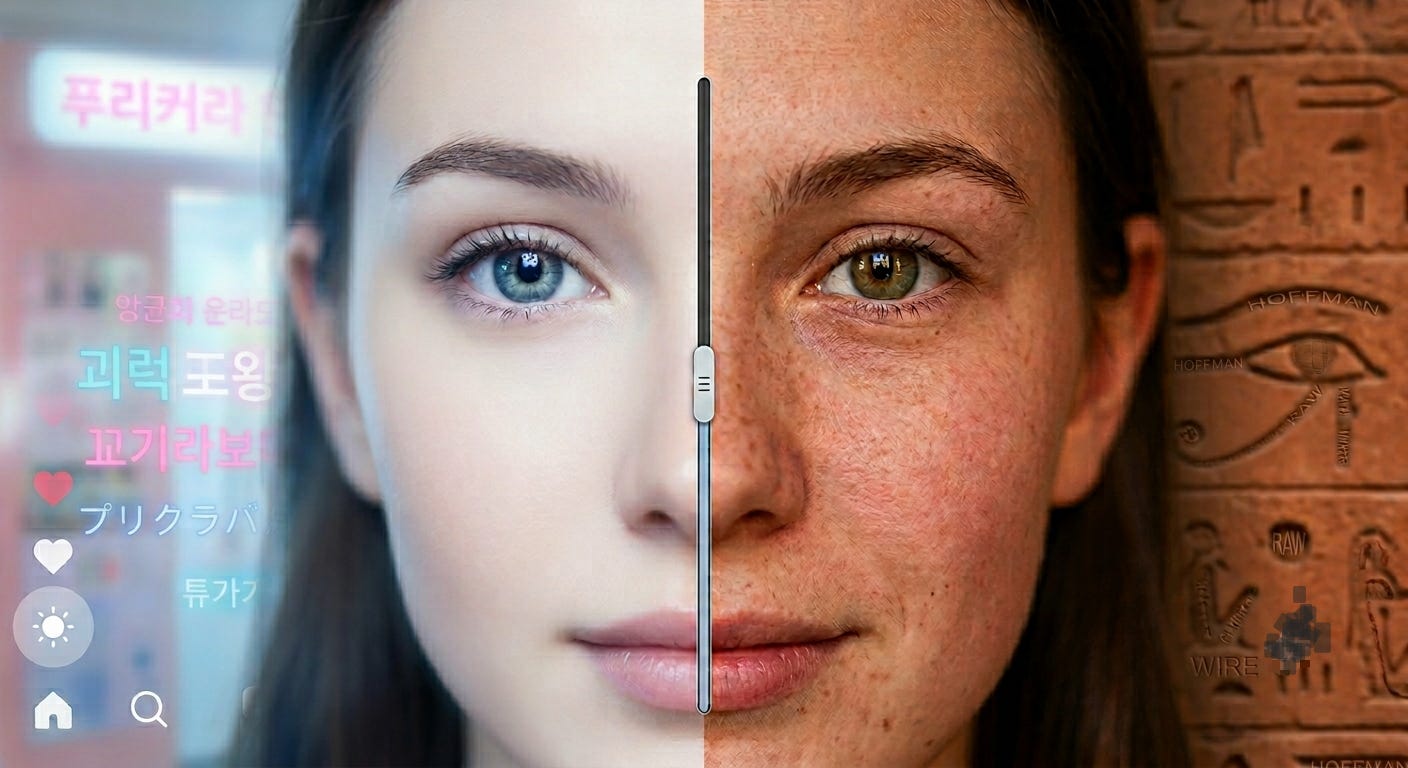
The human desire to reshape the physical frame is not an invention of the digital age. Long before pixels and algorithms, humanity treated the biological body not as a fixed reality, but as a canvas to be altered for power, status, and control. In Ancient Egypt, the Pharaohs and their elite painted their eyes with heavy kohl and ground malachite, using mineral pigments to signal divine lineage and protect against the harsh desert glare. Throughout history—from Roman baths to the powdered faces of eighteenth-century French nobility—society consistently sought to bend raw biology to cultural will.
For centuries, these transformations required physical materials: oils, lead powder, paints, and corsets. When photography arrived in the nineteenth century, darkroom techniques like negative-etching allowed the wealthy to erase wrinkles, but it remained a slow, handcrafted trade. Even as the digital era began, photo manipulation was an expensive, high-friction, highly specialized operation. Airbrushing and facial retouching were strictly confined to professional advertising bays, high-budget fashion magazine spreads, and desktop publishing suites that required thousands of dollars in hardware, software, and technical training. If an amateur attempted to heavily alter their own face for public consumption, the public response was swift, instinctive, and unforgiving: it was mocked as fake, desperate, or ridiculous. Reality remained the unquestioned baseline of human interaction, and digital alteration was an exclusive, highly suspicious exception.
The breakdown of that baseline occurred when ancient behavioral drives met modern smartphone automation in East Asia. This digital shift was rooted in a centuries-old cultural obsession with porcelain, snow-white skin. In imperial China, an ancient idiom declared that one white covers up a hundred defects. Across dynasties, noblewomen applied herbal ointments to achieve a pale complexion, while in feudal Japan, aristocrats layered their faces in thick rice powder. Across these cultures, pale skin was an absolute marker of high social class, proving that one had the luxury of remaining indoors.
In the 1990s, this deeply ingrained behavioral drive collided with interactive technology in Japan. Purikura photo booths allowed teenagers to print customized stickers featuring brightened complexions and enlarged eyes, borrowing directly from the exaggerated visual language of manga and anime. South Korea quickly refined this aesthetic through K-pop culture, normalizing real-time digital skin-whitening via mobile camera applications like Snow.
By the time Chinese tech giants integrated these real-time tracking algorithms into massive e-commerce and live-streaming platforms like Meitu and Douyin, the craze for porcelain skin reached an unprecedented extreme. The software functioned as a seamless digital mask. It allowed millions of users across generations—including older women streaming long shifts under harsh fluorescent lighting—to instantly erase aging, lighten their skin tone, smooth out exhaustion, and present a youthful, lively facade for financial survival in a hyper-competitive gig economy.
When Silicon Valley packaged these exact skin-whitening and facial-smoothing algorithms into mainstream Western applications like Snapchat, Instagram, and TikTok, the transition from an Asian cultural impulse to a global behavioral shift was complete. What began as an ancient status symbol and an Asian workplace utility was rapidly absorbed into everyday Western identity, permanently altering human psychology and daily self-presentation.
Within a decade, the behavioral baseline inverted: the exception became the mandatory default. The human brain was reconditioned to view raw physical reality as defective. A landmark study from City, University of London revealed that ninety percent of young women routinely used filters or editing software before publishing an image online to alter their skin tone, nose shape, or facial geometry. Broader surveys tracking advanced facial-geometry tools showed that three out of five people believed filters actively harmed public mental health, with a third of respondents explicitly admitting they experienced severe visual dysmorphia—wishing they looked in real life the way they appeared through an algorithm.
This created a profound behavioral dysfunction. The raw human face was effectively demoted to an unprepared state. Natural texture—freckles, asymmetrical features, fine lines, and visible pores—was no longer viewed as authentic human variation; it was treated as visual noise, a social faux pas requiring automatic digital correction before exposure to the public eye.
Then came the inevitable cultural breaking point: profound visual and psychological fatigue.
When an entire society becomes hyper-polished, smoothed, and algorithmically uniform, the human nervous system adapts. Synthetic perfection becomes cheap, universal, and automated. As a result, the psychological value system flips completely. When artificial flawless beauty is accessible to anyone with a smartphone, raw human biology—un-edited, un-sculpted, and genuine—suddenly becomes the rarest, highest-value commodity on the market.
This behavioral pivot created the exact conditions for the meteoric rise of Sydney Sweeney.
Sweeney did not break through by conforming to the synthetic, homogenous Instagram Face—she broke through by standing in direct, un-engineered opposition to it. In an era dominated by heavy fillers, dissolved jawlines, and aggressive post-production digital smoothing, she arrived on screen with classic, un-altered physical reality.
Her performance in Euphoria serves as the definitive visual evidence of this behavioral shift. When Sam Levinson’s camera focuses on Sweeney—whether during tender close-ups or her character’s intense, high-stakes OnlyFans narrative arc—it actively refuses to smooth her out. In the famous scene where she taps on the window glass to catch a man's attention, the camera zooms in close and captures everything: her micro-expressions, subtle skin texture, natural flush, and fine freckles.
Even while playing characters operating in environments built on illusion, Sweeney's power on screen stems from a startling, raw vulnerability. She is so visibly un-filtered by modern algorithmic standards that it makes her magnetic to an audience starved for reality. The very texture that a standard smartphone filter would automatically erase is precisely what makes her presence captivating.
This dynamic reached a boiling point when commercial campaigns leaned directly into wordplay surrounding her physical appearance. Taglines playing on her having great jeans versus great genes ignited fierce cultural debate across media outlets. The intensity of the reaction—where commentators clashed over whether her un-edited, classic look represented a return to traditional beauty or a provocative cultural statement—proved just how disruptive a natural physical presence had become to a culture conditioned by filters.
Sweeney’s breakout proved a fundamental truth about where our visual culture sits today: having actual, un-altered good genes—and displaying them on camera without an algorithmic pass—has become a radical act. Her massive appeal is not an accident; it is the natural, inevitable outcome of a culture that spent fifteen years trying to erase human reality, only to realize that true perfection was hidden in everything the filter tried to remove.