

THE DUAL CAMPAIGNS: A TIMELINE OF MISSED OPPORTUNITIES
To understand the magnitude of today’s blunder, one must distinguish between the two separate military efforts that have defined the conflict since February 28, 2026.
THE 12-DAY WAR (FEB 28 – MARCH 11): The initial "Strike Command" phase. This was a lightning campaign of high-intensity synchronization between the U.S. and Israel, focusing on the "Triad of Absolute Goals": Regime Termination, Nuclear Zero-Sum, and Ballistic Castration.
OPERATION EPIC FURY (MARCH 12 – APRIL 8): The subsequent 27-day campaign of sustained pressure, which ultimately saw the transition from a "victory mandate" to a "diplomatic exit."
THE COALITION OF THE RELUCTANT: A LACK OF ALLIED RESOLVE
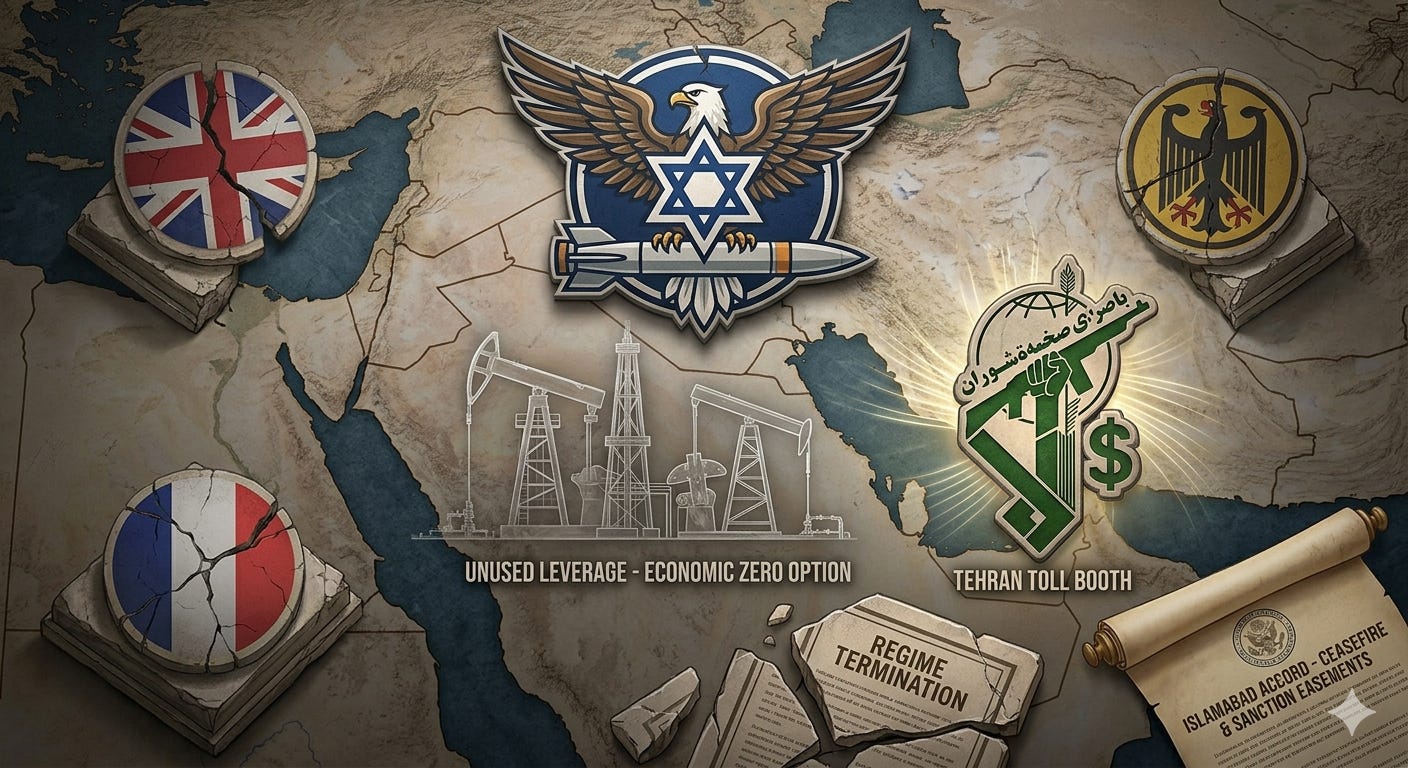
A critical factor that diluted the administration's leverage was the open reluctance of key allies to participate in the offensive throughout both campaigns. While the U.S. and Israel executed Epic Fury, the United Kingdom, France, and Germany took a "nuanced" legal stance.
European leaders explicitly refused U.S. requests to use their military bases for offensive strikes, limiting their involvement to "collective self-defense." This lack of a unified front signaled to Tehran that the Strike Command was an isolated force. Had the allies stood firm on the ultimatum of total infrastructure destruction during either phase, the regime would have faced a global wall of pressure. Instead, the fragmented coalition allowed the "Third Regime" to survive and negotiate.
THE PIVOT: WHEN THE GOALS WERE TRADED FOR GESTURES
The critical shift occurred toward the end of Epic Fury, between March 29 and March 31, 2026. Following the assassinations of top-tier leadership during the first phase, the administration began to redefine "Regime Change."
On March 29, aboard Air Force One, President Trump signaled a pivot, claiming that regime change had "already happened" because the top leaders were dead. By March 31, the mission's definition moved away from the structural replacement of the IRGC and toward simple leadership attrition. This was the moment the "IRGC Replacement" option was officially taken off the table, replaced by a willingness to negotiate with the administrative layers that survived the onslaught.
THE ULTIMATUM STRATEGY: VICTORY THROUGH INFRASTRUCTURE DESTRUCTION
The administration's fatal error was this drift. The strategy should have stayed fixed on the "Economic Zero Option": the systematic destruction of Iran’s energy backbone. Had the administration followed through on the demolition of the oil, gas, and power sectors during the month of Epic Fury, the White House could have declared a definitive victory and withdrawn forces immediately.
By leaving the Iranian economy in ruins, the IRGC would have been shattered structurally. A shattered IRGC loses its ability to pay its proxies and maintain internal order. At that point, the regime would have been the one begging for a deal—not for "ceasefire terms," but for the sheer survival of their state through the lifting of sanctions in exchange for total capitulation.
THE SANCTION TRAP: FUNDING THE RECONSTRUCTION
By entering into the Islamabad Accord today, April 8, 2026, the administration has walked into a tactical trap. Under the guise of a two-week ceasefire and "humanitarian reconstruction," Tehran is already demanding the unfreezing of assets. We are moving from a position of potentially destroying their economy to actively subsidizing its recovery through sanction easements.
CONCLUSION: A VICTORY SURRENDERED
The "Great Capitulation" of 2026 will be remembered as the moment the West held the sword to the throat of its greatest regional adversary across two major campaigns and then chose to lower it for the sake of short-term political stability. By failing to execute the infrastructure ultimatum, the Trump administration has left the IRGC’s structural power intact.
Instead of a self-financing collapse of the regime, we have entered a cycle where the U.S. will inadvertently fund the reconstruction of the very threat it spent weeks trying to erase. True victory required the courage to walk away from the table after the lights went out in Tehran; instead, Washington has chosen to stay and pay the bill for the regime’s survival.
SOURCES, INTELLIGENCE, AND EXPERT DATA
WHITE HOUSE PRESS BRIEFING (APRIL 8, 2026): Confirms the official conclusion of combat operations under Operation Epic Fury and the transition to diplomatic monitoring.
UK PARLIAMENTARY BRIEF (CBP-10521): Documents the Feb 28 mandate and the UK's specific refusal to participate in offensive sorties during the 12-Day War.
POLITIFACT / WHITE HOUSE TRANSCRIPTS (MARCH 29-31, 2026): Verifies the "Mission Accomplished" rhetoric used to pivot from structural regime change to leadership decapitation.
AL JAZEERA / REUTERS (APRIL 8, 2026): Detailed reports on the two-week ceasefire terms and the "Sanction Relief" clauses demanded by Iranian negotiators in Islamabad.
ARGUS MEDIA (MARKET INTEL): Real-time pricing data confirming Brent Crude at $120 and verified reports of IRGC "transit fee" collection in the Strait of Hormuz.
STRATFOR / WORLDVIEW (APRIL 2026): Technical analysis of the "Economic Zero Option" and the missed strategic leverage regarding Iran’s power grid and gas terminals.
IISS MILITARY BALANCE (SPECIAL REPORT MARCH 2026): Documents the survival of IRGC command-and-control structures despite the initial Strike Command phase.