

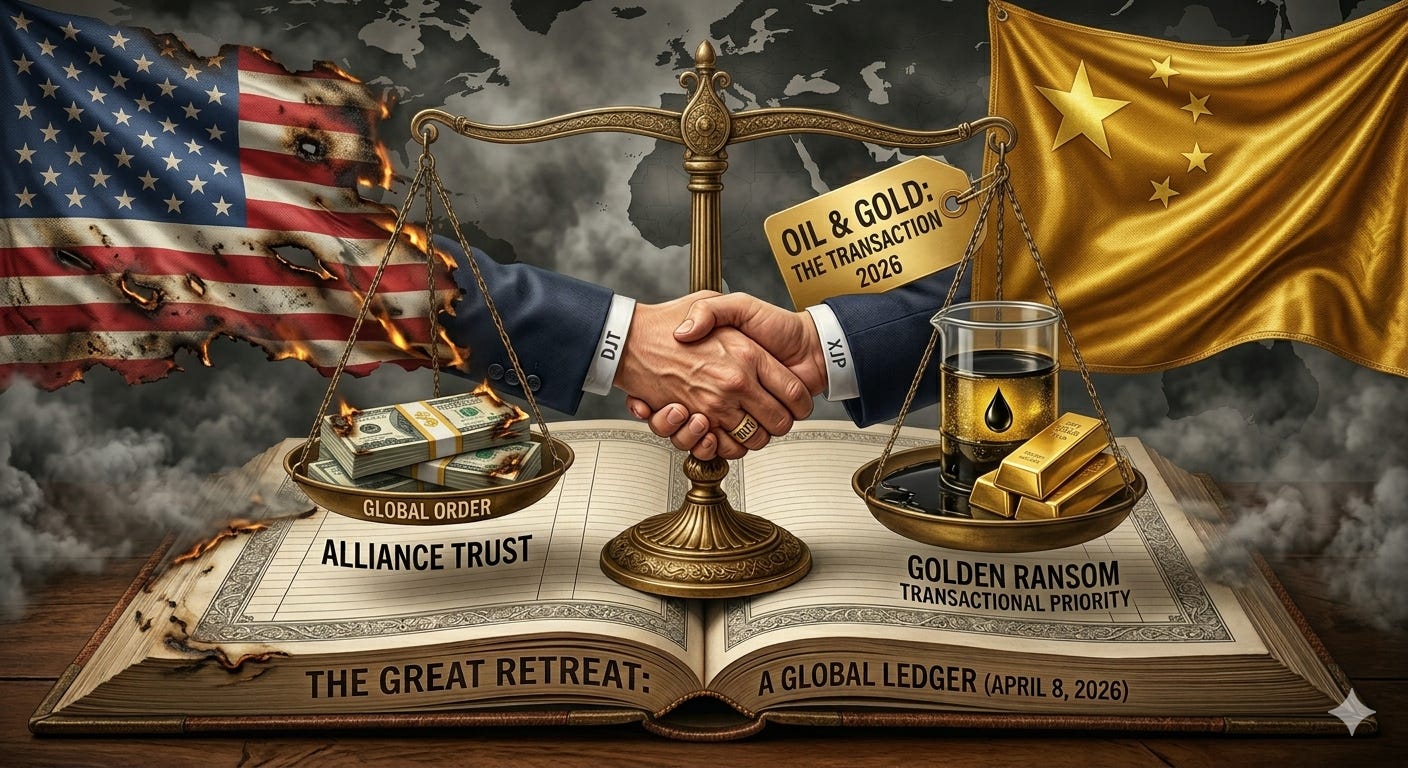
The events of this Wednesday, April 8, 2026, have confirmed the most radical geopolitical shift in modern history. While the world was focused on the smoke over the Persian Gulf, the real explosion happened within the American State Department.
The shift is no longer a theory; it is a transactional reality. China isn’t just watching the conflict—they are conducting the autopsy of the American Century.
The Tokyo Fracture: Allies as Liabilities
The most jarring aspect of the current shift is the public deterioration of the U.S.-Japan alliance. Historically the cornerstone of Pacific security, Tokyo is now being treated as a delinquent debtor.
President Trump’s condemnation on Monday, April 6, 2026, regarding Japan’s refusal to deploy destroyers into the Persian Gulf has fundamentally altered the trust between the two nations. By publicly questioning why the U.S. defends the First Island Chain while Japan “didn’t help us” with the war or the oil, the administration has signaled that the 1960 Treaty of Mutual Cooperation and Security is now subject to a service fee.
For Japan, the message is clear: the U.S. cavalry may not come unless the check clears and the political alignment is absolute. This leaves a massive vacuum in the Pacific that Beijing is already moving to fill.
The Fear of the Collapse
Beijing’s calculation is chillingly simple: America is afraid. For the first time, the U.S. administration has signaled that the global economy is a higher priority than the global order. President Trump’s recent assertions that he is consulting with Xi Jinping on Taiwan arms sales prove that sovereignty has become a bargaining chip.
If the U.S. is unwilling to crash the markets to save its own energy security in the Middle East, why would it do so for an island in the Pacific or a partner in Tokyo?
The Half-Trillion Dollar Surplus: A Golden Ransom
The most overlooked technical detail in this shift is the sheer scale of Taiwanese liquid wealth. As of the end of March 2026, the Central Bank of Taiwan reported a foreign exchange reserve surplus of $596.89 billion.
In a transactional Washington, this half-trillion dollars is viewed less as a strategic reserve for a democratic ally and more as a “Golden Ransom.” The administration’s “Pay for Protection” logic has turned Taiwan into the world’s wealthiest customer for aging hardware.
The Hand-Me-Down Defense
Despite its wealth, Taiwan is being forced into a secondary market for its defense. Instead of the latest F-35 variants, Taipei is being pushed to clear out Western inventories of older tech:
The U.S. Inventory Clear-Out: Taiwan is currently the primary buyer for refurbished M109A7 Paladin howitzers and older M1A2T Abrams tanks. Washington is essentially charging new-technology prices for equipment the U.S. military is looking to transition away from.
The European Pivot: With the U.S. preoccupied, Taiwan has sought silent partners. France and the Netherlands have quietly engaged in submarine component deals, but only under conditions that ensure no disruption to their own trade with Beijing.
The Tech Fire Sale
The upcoming summit between President Trump and President Xi Jinping—now rescheduled for mid-May—is not about regional stability; it is about the price tag of American withdrawal. Under Treasury Secretary Scott Bessent, the Pax Silica initiative is being reshaped into a framework for managed trade. The technical details are devastating:
The Case-by-Case Surrender: In January 2026, the Department of Commerce shifted the export policy for NVIDIA H200 chips to China to a case-by-case evaluation. This allows China legal access to frontier AI hardware in exchange for a 25% surcharge and massive agricultural purchases.
The Reshoring Ransom: Taiwanese firms are being pressured to move high-end production to U.S. soil. In the eyes of Beijing, this is the U.S. packing its bags before the storm hits.
The Summit of the Survivors
The meeting in Beijing will focus on one thing: how to divide the spoils. Xi Jinping is expected to push for a formal U.S. commitment to consult with China on all future arms sales to Taiwan.
If Trump agrees, the Taiwan Relations Act is effectively dead, replaced by a personal understanding between two leaders who view the world through a ledger. China looks at Taiwan and Japan today and doesn’t see fortresses; they see fruits that are ripening because the gardener is too afraid of the cost of the harvest.
Intelligence & Source Log (April 8, 2026)
Central Bank of the Republic of China (Taiwan): Press Release: Foreign Exchange Reserves as of the End of March 2026 ($596.89B Surplus). April 7, 2026.
White House News Conference: Transcript of President Trump’s remarks on NATO, Japan, and Australia’s lack of support in the Iran conflict. April 6, 2026.
Department of Commerce / BIS: Revised guidelines on Nvidia H200 AI chip exports to China. January 14, 2026.
State Department: Secretary Marco Rubio’s Fox News interview regarding the reexamination of the NATO alliance and base access. April 1, 2026.
Institute for the Study of War (ISW): China & Taiwan Update: Taiwan’s $40 billion special budget for unmanned systems and procurement delays. April 3, 2026.
Lowy Institute: Analysis of the Tokyo-Washington rift and the failure of the “Cornerstone” alliance. April 7, 2026.