


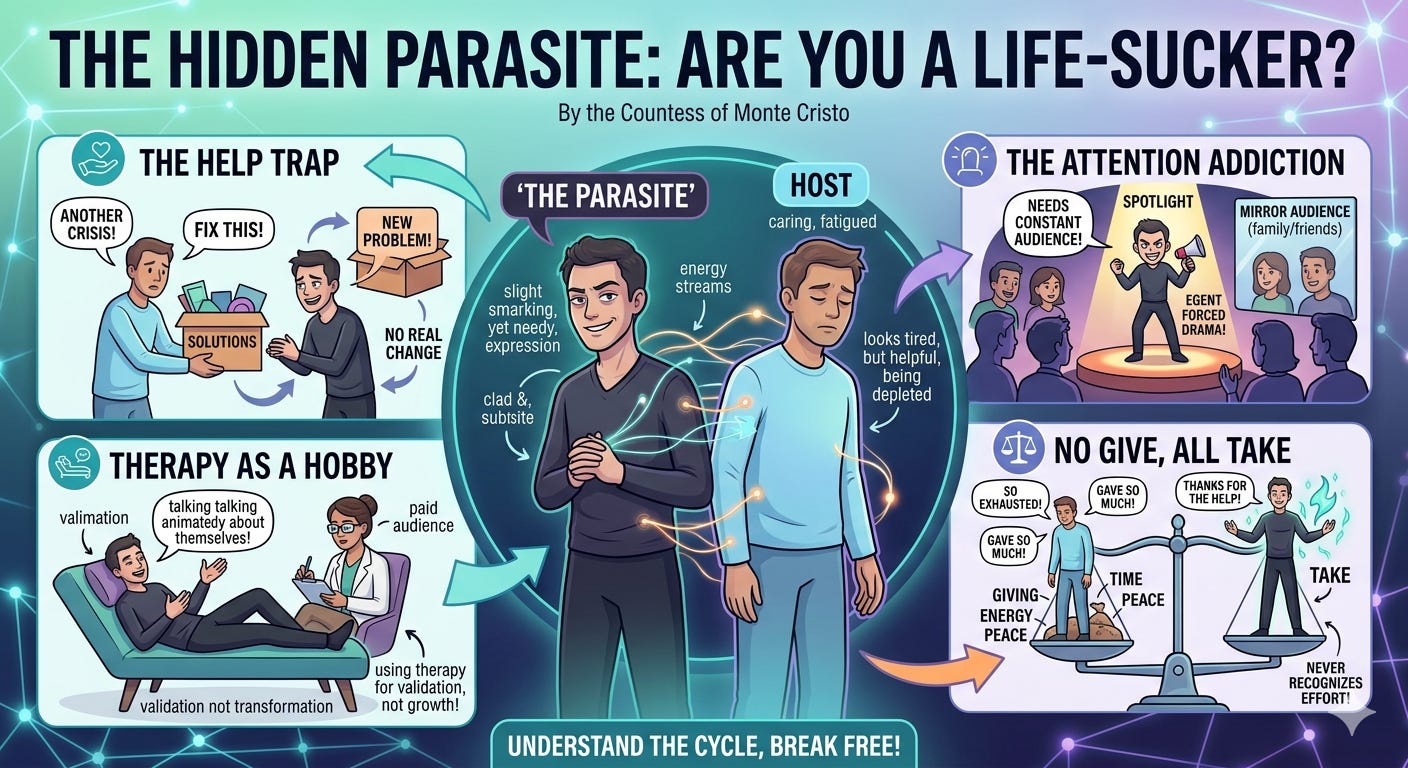
Most people think a parasite is just a bug or a tick. But in psychology, a person can be a parasite. They don't just take your money; they take your time, your energy, and your peace of mind.
⠀
Here is how to spot parasitic behavior in plain English:
⠀
1. The Help Trap
⠀
Parasites are always in "crisis." There is always a problem that only you can fix. They don't want a solution; they want your effort. If you solve one problem, they will immediately find a new one to keep you hooked.
⠀
2. The Attention Addiction
⠀
A parasitic person cannot be alone with their own thoughts. They need to be "seen" at all times. They use friends and family like a mirror to prove they exist. If you aren't looking at them, they feel like they are disappearing, so they create drama to force you to watch.
⠀
3. Therapy as a Hobby
⠀
For most, therapy is work to get better. For a parasite, therapy is just another place to talk about themselves for an hour. They go to therapy not to change, but to have a professional audience. They use "mental health" as an excuse to never grow up and never stop taking from others.
⠀
4. No Give, All Take
⠀
A healthy relationship is a two-way street. A parasitic relationship is a vacuum. They flourish while you get tired, broke, and stressed. If you stop helping, they don't say "thank you for everything"; they get angry because their supply has been cut off.
⠀
⠀
The Evidence: Why This Happens
⠀
Weaponized Dependency: The American Psychological Association (APA) identifies these patterns in personality disorders where individuals manipulate others to ensure they are perpetually taken care of.
The "Active-Dependent": Psychological expert Theodore Millon (2011) describes these individuals as "Active-Dependents"—people who are busy hunting for someone to drain.
Resistance to Growth: Expert Martha Stark (1994) confirms that many "parasites" use therapy as a shield. They talk to avoid doing the actual work of changing their behavior.