


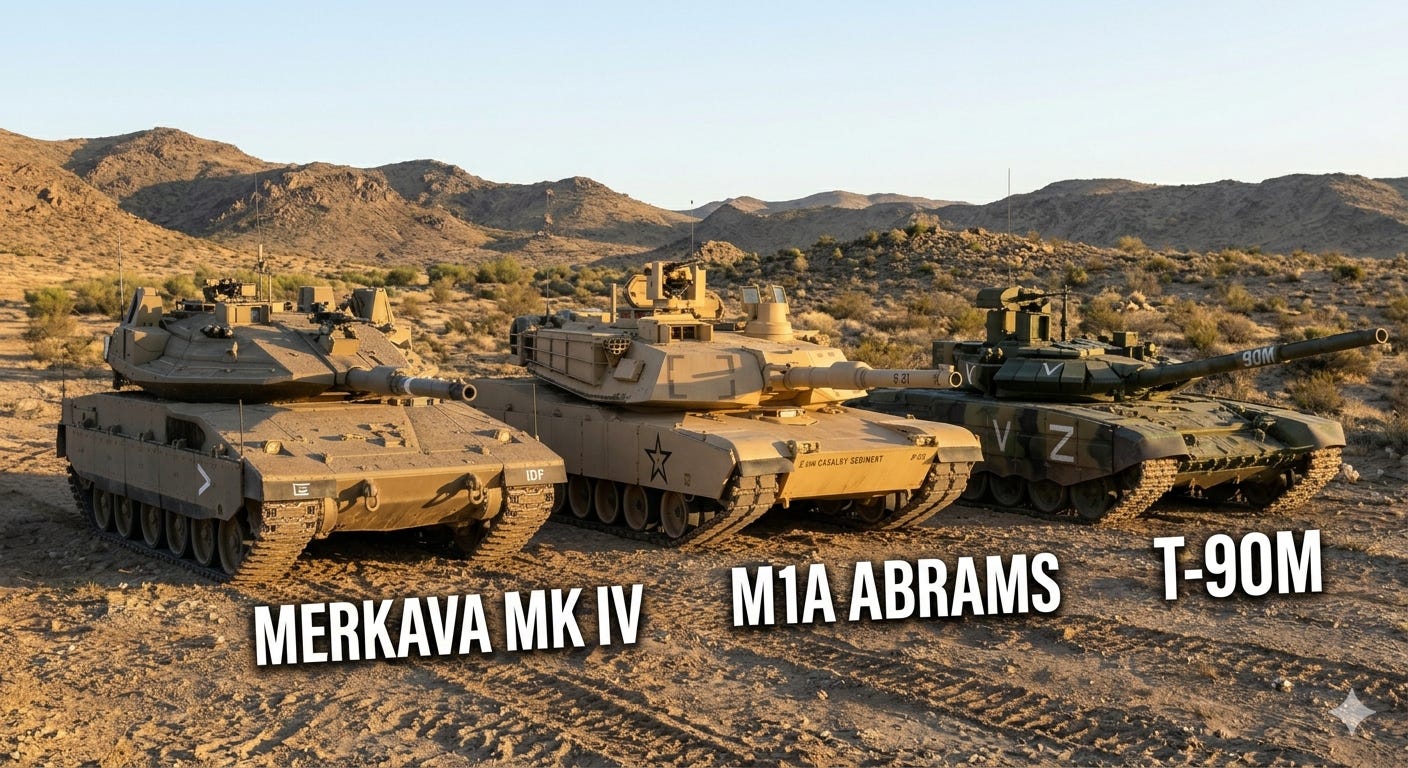
For over a century, the Main Battle Tank (MBT) has been the undisputed king of the land. From the mud of the Somme to the deserts of Iraq, these 70-ton steel giants defined military power. However, real-world data from the last three decades—and specifically the brutal lessons of the last 24 months—confirms a hard truth: The era of the heavy tank is over.
A Legacy of Vulnerability: From Grozny to Afghanistan
The myth of the invincible tank began to crumble long before the current drone revolution.
The Urban Trap (Grozny, 1994): During the First Chechen War, Russian armored columns entered the city of Grozny with overwhelming force. Within hours, the 131st Maikop Brigade was virtually annihilated. They lost 102 out of 120 vehicles to cheap, hand-held RPGs fired from rooftops and basements. It was the first modern proof that heavy armor is a liability in close-quarters combat.
The Top-Down Threat (Afghanistan): In the rugged terrain of Afghanistan, Soviet tanks were repeatedly neutralized by mujahideen fighters who used high-ground ambushes to strike the thin armor on top of the turrets. This "top-down" vulnerability has never been truly solved—it has only been exploited by more sophisticated technology.
The $500 Killer: The New Math of War
The modern battlefield is no longer defined by who has the thickest steel, but by who has the cheapest, most precise "eye in the sky." In Ukraine and Gaza, we are witnessing a staggering economic asymmetry.
A modern Merkava IV or M1 Abrams costs between $6 million and $10 million. Yet, data shows these machines are being "toppled" by $500 First-Person View (FPV) drones. These drones do not need to punch through a meter of front armor; they simply fly 10 centimeters above the ground to evade radar, loiter behind the tank, and strike the rear engine deck. When a $500 toy can destroy a $10 million asset, the tank is no longer a strategic tool—it is a massive financial and human risk.
The Failure of Passive and Active Defense
Even the most advanced protection systems are struggling to keep up.
The "Windbreaker" Gap: Israel’s Trophy (Windbreaker) system is a marvel of engineering, designed to intercept high-velocity missiles. But as seen in recent operations in Lebanon and Gaza, it has a "speed floor." FPV drones can fly slowly enough to stay below the detection threshold of radar.
Saturation Tactics: Modern insurgents have learned to fire a "distractor" rocket to trigger the defense system, followed immediately by a drone that strikes while the system is recycling or the crew is disoriented.
The Evolution: From Iron Giants to Data Nodes
The hypothesis is simple: to survive, the tank must "shrink or die." We are moving toward a battlefield where size is a death sentence. The future of armored warfare rests on two pillars:
360° Hemispheric Awareness: Future vehicles must possess 360° optical and acoustic sensors capable of detecting a drone flying inches above the grass.
The Link 16 Revolution: Every vehicle must be a "Link 16" node—fully networked and sharing real-time data with every drone, satellite, and infantryman in the theater.
Conclusion
The United States has avoided massive tank losses recently because it relies on aerial supremacy and precision-guided munitions—essentially doing the tank's job from the sky. The Marine Corps has already divested its heavy armor for this very reason.
The tank's role as a 70-ton "battering ram" is finished. The future belongs to small, agile, 20-ton autonomous or semi-autonomous machines that prioritize Electronic Warfare and Connectivity over iron plating. The king is dead; the network has taken the throne.