


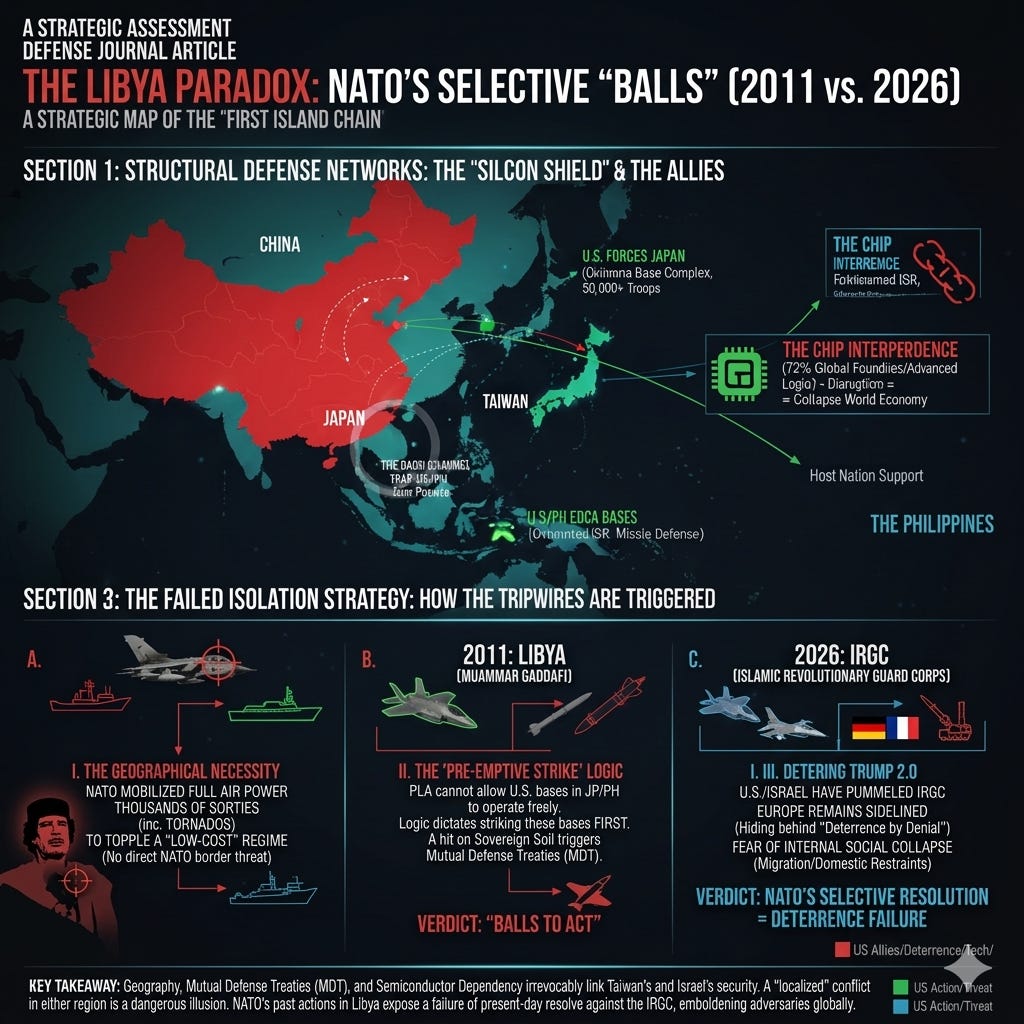
The Silicon Shield and the Illusion of Choice
The prevailing theory in modern statecraft—that a conflict can be surgically isolated to a single geography—is a dangerous fallacy. In 2026, the global economy is tethered to a "Silicon Shield." With Taiwan controlling roughly 72% of the global semiconductor foundry market and 90% of advanced logic chips, any kinetic action in the Taiwan Strait is not a local dispute; it is a direct assault on the central nervous system of the global economy.
Even under the "America First" posture of the Trump administration, the strategic extraction of Taiwanese technology is a multi-hundred-billion-dollar U.S. national security priority. An "isolated" war that allows this infrastructure to fall or be destroyed would result in a domestic U.S. energy and tech crisis more severe than the 1970s oil embargo.
The Bashi Channel: A Physical Impossibility
Strategically, China cannot "just take Taiwan" while leaving Japan and the Philippines untouched. To successfully blockade the island, the People’s Liberation Army (PLA) must dominate the Bashi Channel. This channel is not empty space; it is the frontline of the First Island Chain, bordered by northern Philippine islands and Japanese territorial waters.
Because the U.S. has integrated its defense networks with Japan and the Philippines through EDCA and Mutual Defense Treaties (MDT), a PLA move into these waters constitutes a violation of sovereign territory. Military logic dictates that for China to succeed, it would have to strike U.S. assets in Okinawa and Luzon first. The moment American service members are killed on allied soil, the "choice" to stay out of the war vanishes.
The Libya Paradox: NATO’s Selective "Balls"
It is a glaring historical absurdity that in 2011, NATO mobilized its full air power—launching thousands of sorties and deploying advanced assets like the Panavia Tornado—to topple Muammar Gaddafi in Libya, a regime that posed no direct threat to the alliance’s borders. Yet, in 2026, they refuse to apply that same "Libya Model" to the IRGC.
As we speak, the United States and Israel have already pummeled IRGC infrastructure in joint operations, proving the target is vulnerable. However, Europe remains on the sidelines. A joint operation with European participation would likely force a much more favorable and definitive peace agreement than what President Trump can achieve through unilateral pressure alone. By holding back, NATO isn't just showing a lack of resolve; they are sabotaging the leverage needed to end the IRGC threat once and for all.
NATO’s Internal Firewall: The Social Tripwire
Despite at least three ballistic missile incidents entering Turkish airspace in March 2026, NATO’s response remains paralyzed. This hesitation stems from a "social tripwire":
Weaponized Migration: European capitals fear that a symmetric war with Iran would trigger an internal collapse. Decades of mass migration have created a "domestic front" where governments fear civil unrest at home more than missiles at their borders.
The Two-Tier Alliance: There is a clear disparity in urgency. If these missiles had struck Rome or Paris, the response would be immediate. Because they hit the Turkish "buffer," the alliance hides behind "Deterrence by Denial" rather than "Deterrence by Punishment."
The 2026 Reality
The IRGC and the PLA both monitor this fracture. When NATO hesitates to defend its own borders against the IRGC, it sends a signal to Beijing that the "will to fight" is broken. Physical geography and the semiconductor supply chain mean that there are no "low-cost" regimes left to topple. Any move in one corner of the globe will inevitably pull the rest of the world into the fire.