


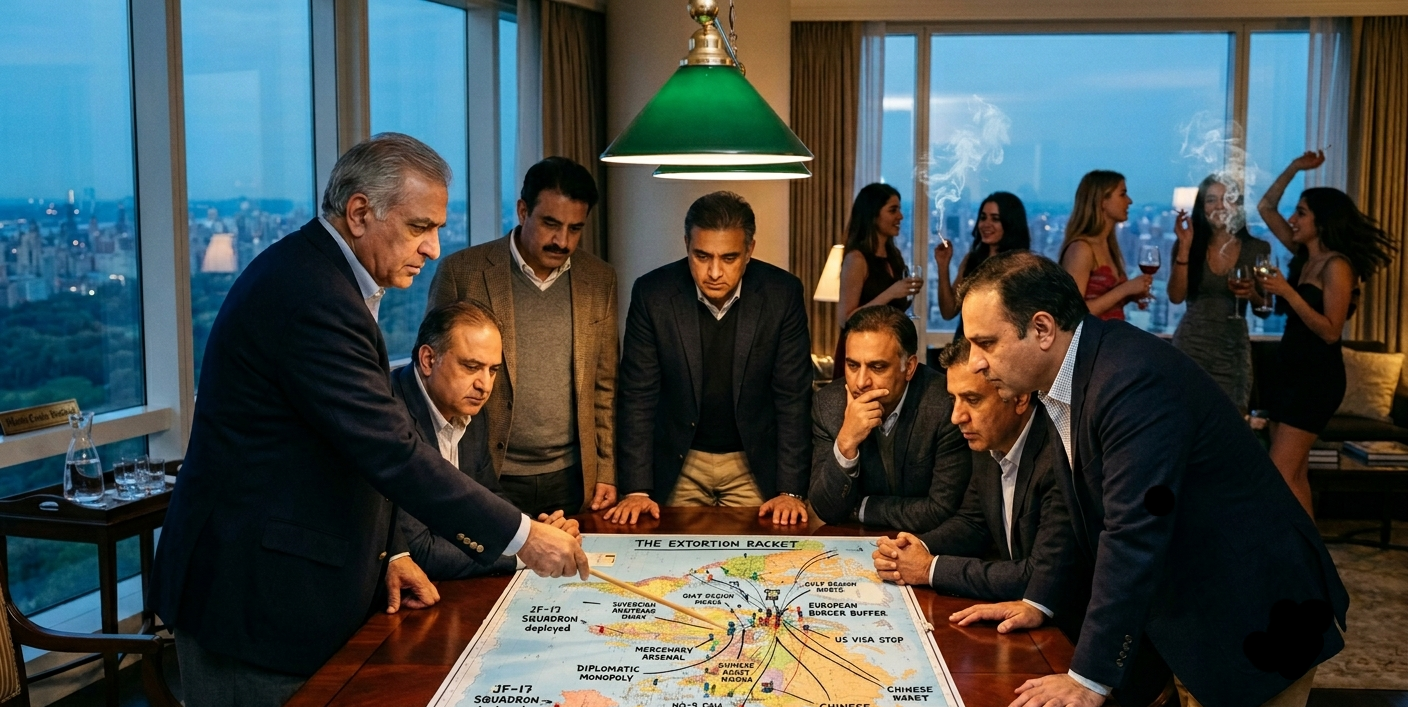
The balance sheet of a modern state is rarely an accounting of wealth; more often, it is a ledger of captivity. To understand the trajectory of Pakistan is to understand an economy structurally engineered around perpetual triage, where sovereignty is systematically traded for liquidity. The baseline figures outline a mathematical trap. Pakistan’s total external debt stands at a staggering 137.5 billion dollars. When combined with a crushing internal ledger, the state’s total public debt has surged to 80.52 trillion rupees, pushing the debt-to-GDP ratio to an oppressive 71.7 percent. This is not managed leverage; it is a terminal arrangement. In this environment, debt servicing ceases to be a budgetary line item and becomes a predatory mechanism, routinely consuming up to two-thirds of all government revenue. The math is simple, cold, and unyielding: nearly every rupee extracted from the domestic economy bypasses the state infrastructure entirely, routed directly into the hands of foreign central banks, institutional syndicates, and the IMF to service the interest on old illusions. The state no longer borrows to build; it borrows to survive the next fiscal quarter, permanently tethered to an external life-support system that dictates its domestic policy from afar.
This nuclear-armed syndicate survives entirely on the monetization of its own collapse and the export of geopolitical terror. This is not an economy or a traditional republic; it is a highly sophisticated, state-level protection racket. By treating its conventional military as a rentable proxy force, its strategic geography as a diplomatic filter, and its hollowed-out population as an extractive financial pipeline, Islamabad has constructed an equilibrium of extortion. It does not exist despite global crises, but thrives entirely because of them.
THE RENT-A-MILITARY PROGRAM: AIR DEFENSES FOR HIRE, OIL PAYMENTS ACCEPTED
The relationship between Islamabad and Riyadh has discarded any remaining diplomatic pretense. It has hardened into a raw, transactional shakedown: physical protection in exchange for economic life support. Under the bilateral Strategic Mutual Defence Agreement signed at Al-Yamama Palace in Riyadh, Pakistan activated a massive combat-capable deployment to Saudi Arabia’s Eastern Province following regional kinetic escalations. Security tracking confirms a live footprint of 8,000 active troops stationed on Saudi soil.
This is a fully integrated combat detachment. It features a full squadron of approximately 16 JF-17 Thunder fighter aircraft and a Chinese-origin HQ-9 long-range surface-to-air missile system deployed directly to the Kingdom to protect Saudi energy infrastructure from regional rocket and drone salvos. The architecture of this arrangement is brilliantly cynical. Because the JF-17 and HQ-9 are Chinese-designed assets, they operate entirely outside of United States International Traffic in Arms Regulations export controls. Saudi Arabia is effectively bypassing Western congressional oversight, red tape, and human rights vetos by leasing a sovereign military to guard its airspace.
The confidential clauses of the agreement allow Riyadh to request and fund a total scale of up to 80,000 Pakistani personnel if its borders are systematically compromised. The price for this mercenary shield? Riyadh has extended critical financial lifelines—including billions in direct central bank deposits and deferred oil payments—to keep the central bank in Islamabad from crossing the threshold of default.
THE CRISIS BROKER SYNDICATE: CASHING IN ON EVERY REGIONAL FIRE
As the United States and the Islamic Revolutionary Guard Corps engage in regional conflict, Pakistan has successfully monopolized the primary backchannel of communication. The Islamabad Opening—which brokered a temporary, fragile ceasefire—was handled not by traditional diplomats, but through direct, quiet coordination between Pakistani Army Staff Chief Asim Munir, US Vice President JD Vance, and Iranian Foreign Minister Abbas Araghchi.
This is a dark, historical loop. Decades ago, Islamabad leveraged its position to broker Nixon’s opening to China; later, it pocketed billions from Western intelligence while acting as a host and gateway for transnational terror hotspots, a reality permanently stamped by the 2011 Abbottabad raid that eliminated Osama bin Laden. Today, the playbook remains identical. Pakistan uses a too volatile to fail doctrine. By holding the diplomatic keys to Tehran's Supreme National Security Council while simultaneously pointing to its own expanding nuclear arsenal, Pakistan effectively holds the global economy hostage. The message to the West and the IMF is quiet but clear: Underwrite our debts, or watch a nuclear-armed state next to a hot war zone collapse into absolute chaos.
THE HUMAN EXPORT BUSINESS: SHIPPING CITIZENS, IMPORTING FOREIGN CURRENCY
The staggering presence of the Pakistani diaspora across global markets is often analyzed as a passive migration crisis. In reality, it is a deliberate, state-managed macroeconomic extraction policy. Personal remittances sent home by overseas Pakistani workers constitute the literal life-support system of the sovereign state, bringing in between 27 billion and 30 billion dollars annually. This capital inflow regularly outpaces Pakistan's entire physical export sector and completely dwarfs its Foreign Direct Investment. Over 50 percent of this hard currency originates directly from laborers in the Gulf, creating an immediate structural loop back to Islamabad's military commitments. Where this population goes depends entirely on hard, cynical bilateral deals.
On the European Front, the European Union actively participates in this transactional migration. Through frameworks like the EU-Pakistan Talent Partnership, Brussels coordinates legal migration pathways and Technical and Vocational Education funding. In exchange, the Pakistani security state acts as an external border buffer, aggressively suppressing irregular migrant smuggling routes and executing the swift readmission of deported nationals. The EU is essentially paying the Pakistani security state to act as a frontier buffer zone.
On the American Front, this demographic leverage has hit an absolute wall in Washington. Under Presidential Proclamation 10998, which took full effect on January 1, 2026, the United States suspended or heavily restricted entry and visa issuances for nationals of 39 countries, including Pakistan, due to security screening criteria and identity-management deficiencies. Furthermore, the U.S. Department of State instituted a categorical pause on all immigrant visa issuances for Pakistani nationals. Washington has completely decoupled its regional security reliance on Islamabad from its domestic immigration policy, refusing to let geopolitical favors dictate entry at its borders.
THE GEOPOLITICAL CIRCUS ACT: JUGGLING BEIJING, MOSCOW, AND BANKRUPTCY
To sustain this racket, Pakistan must perfectly balance its dependencies between competing superpowers, acting as China’s ultimate regional tool while managing a calculated, tactical thaw with Moscow. Data from the Stockholm International Peace Research Institute confirms that China supplies over 75 percent of Pakistan's major conventional weapons systems, and Pakistan consumes a massive 61 percent of China's entire global arms exports. Beijing treats Pakistan as a frontline proxy designed to anchor India's military focus permanently to its western border, securing China’s own regional dominance without deploying a single Chinese soldier to South Asia.
Concurrently, the political relationship between Moscow and Islamabad has shifted from Cold War hostility into a pragmatic, tactical thaw. Managed through the Russia-Pakistan Consultative Group on Strategic Stability, this relationship is driven by two narrow goals: preventing the spillover of transnational terrorism from Afghanistan into Central Asia, and providing Russia with an alternative energy destination for discounted crude oil and LNG to bypass Western sanctions.
However, this northern arbitrage faces a hard glass ceiling. Moscow’s broader South Asian strategy remains completely India-centric. New Delhi is Russia’s primary economic partner and defense buyer in the Global South. Russia will engage Islamabad for tactical convenience but will never provide Pakistan with top-tier technology or strategic depth that risks alienating its foundational alliance with India.
THE FINAL LIABILITY: WHEN THE DOUBLE GAME FINALLY EXPLODES
The critical vulnerability of this entire model is that it relies on a protection racket that is structurally impossible to maintain indefinitely. Pakistan is currently using its troops to operate air defense systems protecting Saudi Arabia from Iranian-backed rocket and drone fire, while simultaneously trying to act as the neutral diplomatic shield and intermediary for Iran in peace talks with the United States.
This is a high-stakes double game played on a razor’s edge. If a kinetic strike hits a Saudi facility and kills Pakistani service members operating those air defenses, the illusion of neutral arbitrage instantly disappears. Islamabad will be forced to choose between its financial guarantors in Riyadh or its immediate neighbor in Tehran—and the very instability it uses to extort the world will finally consume it.