

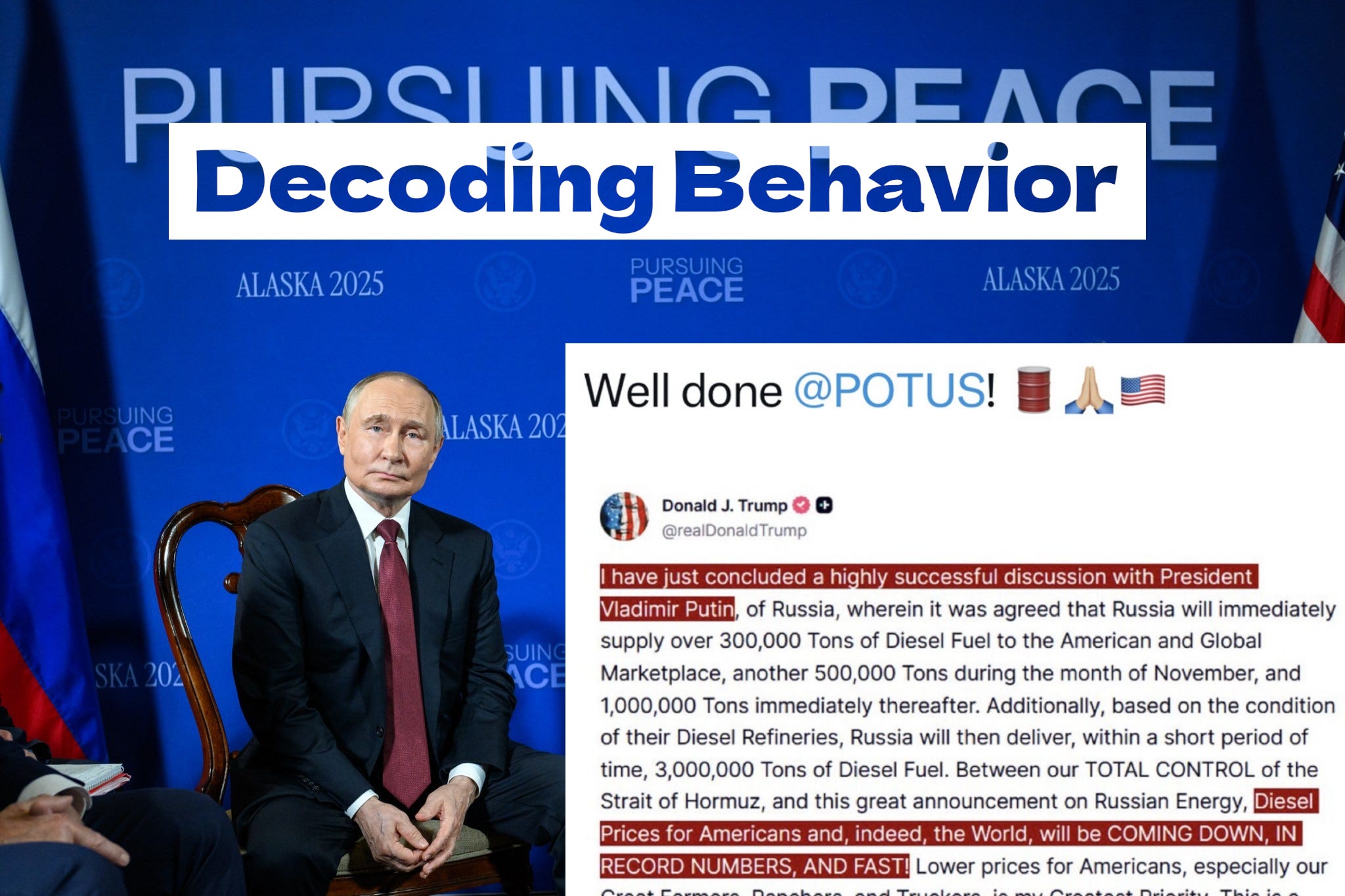
Listen to mainstream television commentary or read the endless loop of internet military analysts losing their minds over the U.S. Treasury’s Office of Foreign Assets Control issuing General License No. 135. They are screeching about moral hypocrisy, abandoned principles, and short-term political panic over gas station price tags.
They are completely hoodwinked.
These self-proclaimed defense commentators are so high on their own moralizing scripts that they treat a massive realpolitik pivot as an isolated accident. What they write off as erratic dealmaking or surface-level noise is actually the opening wedge of a grand strategy: dragging Russia back into the Western economic orbit before Beijing permanently converts the Russian Federation into a resource-exporting vassal state.
The Sanctions Farce: Circumventing Their Own Rules on the Taxpayer’s Dime
While the talking heads hyperventilate about direct energy deals, Western capitals spent years running one of the most absurd economic farces in modern history.
The mechanism was elementary: Russian crude oil never actually stopped flowing; Western governments simply designed a legal loophole to circumvent their own sanctions. Tankers loaded up at Russian ports, sailed to third-party hubs in India and Turkey, and offloaded crude that was instantly refined into diesel, gasoline, and jet fuel. Once processed on foreign soil, those exact same Russian molecules were legally rebranded and shipped straight into Western-aligned markets.
Western taxpayers—the gullible ones who actually believed the politicians and military analysts on television—were the only ones left holding the bill. They paid an inflated “middleman tax” that lined the pockets of foreign refiners and third-party intermediaries, while the actual resource extraction and physical supply chains remained completely undisturbed. The sanctions didn’t stop Russian energy; they merely created a multi-billion-dollar laundering scheme that bled everyday citizens to maintain a moralizing public performance.
The Ukraine Smokescreen: When the Jig Was Up
This hypocritical game worked seamlessly until Ukraine started blasting Russian energy infrastructure with long-range drones.
When Ukrainian strikes began hitting Russian refineries, the entire carefully constructed laundering mechanism faced collapse. The drone attacks disrupted the very supply chains Western markets relied on through India and Turkey, threatening a catastrophic global supply squeeze. The jig was up. Western governments could no longer hide behind the Indian middleman trick, and Washington went ballistic.
Mainstream pundits viewed Washington’s public browbeating of Volodymyr Zelensky—and the demands for Ukrainian strikes on Russian energy targets to stop—as mere erratic outbursts. That is complete intellectual blindness. Washington hit back at Kyiv with brutal force because Ukraine’s tactical wins were threatening to blow the lid off the West’s economic deception and derail the grand strategic board.
Kyiv served its purpose in bleeding Russian conventional forces, but when its actions threatened to expose the energy illusion and push a desperate Russia into China’s arms, Ukraine was systematically squeezed, sidelined, and sacrificed on the altar of grand realpolitik.
The Iran Cover and the Post-WWII Eurasian Objective
The timing of the public shift was not a random whim. The escalation of war in the Middle East and the fallout from the conflict with Iran created a brutal market shock, pushing global fuel routes into chaos and sending domestic diesel soaring. That crisis provided Washington with the ultimate narrative cover.
You cannot easily explain a sudden, direct pivot toward Moscow to a Western public fed on years of anti-Russian rhetoric. But you can point to a burning Middle East, blame soaring pump prices, blame refinery disruptions, and ease sanctions under the banner of immediate consumer relief.
The West has wanted to pull Russia away from the East and integrate its economy since the end of World War II. When China transformed into an economic juggernaut, a completely isolated Russia sitting on a vast Asian continent became an existential liability for the Western world. The Iran shock simply provided the geopolitical cover to finally execute what strategic minds have been planning for decades: welcoming Moscow back into the Western fold before Eurasia is completely lost.
Taiwan Is Pageantry—Siberia Is the Real Prize
Meanwhile, military analysts are staring at the wrong map. Watch them obsess over amphibious assault routes in the Taiwan Strait. An invasion of Taiwan makes for great domestic patriotic theater for Beijing, but as an actual military operation, it would be the greatest blunder of the 21st century.
If China attacks Taiwan, it would instantly trigger an economic catastrophe, plunging Beijing into the harshest, most severe economic isolation and hardship since the dark days of Mao Zedong. Sanctions, blockades, and the total destruction of global microchip supply chains would freeze Chinese export industries, collapse its banking sector, and bring domestic manufacturing to a grinding halt.
Beijing knows this. China does not need to fire a single missile across the strait and destroy its own economy when the real prize is sitting unprotected directly to its north.
Siberia holds the vast majority of Russia’s energy, timber, fresh water, and critical minerals. Following years of Western economic isolation, Moscow has been forced into dark, asymmetrical bargains to keep its state afloat. China has been buying Russian pipeline gas through Power of Siberia at massive discounts compared to what European buyers used to pay. Beijing is using the classic Ottoman-empire playbook: crushing economic attrition without firing a shot, demanding deeper concessions, and buying up Russia’s sovereignty line by line.
The Demographic Vacuum: Why Beijing Doesn’t Need a War
What the talking heads ignore is the demographic math that makes this conquest inevitable. The entire Russian Far East and Siberia combined hold fewer than 25 million people spread across a landmass larger than Europe and the United States put together. Just across the border, China’s northeastern provinces house over 100 million people.
Moscow cannot populate, work, or defend its eastern flank. Chinese state-backed corporations, agricultural ventures, and timber logging operations already operate vast swathes of Siberian land under long-term leases. Beijing isn’t invading Siberia with tanks; it is populating and buying it through slow, demographically driven soft colonization.
Moscow’s Existential Trap and the Western Lifeline
Russia is terrified. The Kremlin constructed a massive anti-Western propaganda machine to appease domestic pride, but deep down, Russian deep-state officials know their real existential threat isn’t NATO—it is being swallowed whole by China.
Russia’s deep-state apparatus suffers from a severe, enduring psychological paradox: its elite and its strategic planners have always fundamentally identified as part of European civilization, not Asia. Decades of anti-Western rhetoric are nothing more than a superficial state-sanctioned theater. Beneath the surface, Moscow’s ruling class knows that cultural, historical, and institutional survival belongs to the West. Being absorbed into an Asian sphere of influence isn't just a geopolitical defeat—it is a total civilizational erasure that terrifies the Kremlin far more than any alliance or compromise with Washington.
Moscow knows it cannot pay off its economic IOUs to Beijing in cash. When the bill comes due, China will demand payment in Siberian land, resource rights, and geopolitical subordination. Russian leadership is trapped in its own rhetoric, unable to openly tell its populace that its ultimate survival requires an economic off-ramp back toward the West.
The fuel deal is that exact backdoor rescue line. It allows Moscow to begin re-linking its economy with Western capital and markets without forcing the Kremlin to publicly admit that its anti-Western campaign was a strategic dead end.
The European Double Game: Rearming for Show While Washington Pulls the Strings
Watch European capitals double their defense spending and listen to their media scream about an imminent Russian invasion. It is a masterclass in political theater.
Europe is playing a calculated double game. Their governments arm themselves to the teeth and fund defense drives to satisfy domestic left-wing, far-left, and anti-Moscow political blocs, keeping public hysteria burning bright to appease their voters. But behind closed doors, European leadership and Washington share the exact same long-term goal.
This is precisely why NATO never triggered Article 5 to force a direct, total war with Russia. Western military planners knew all along that an apocalyptic crash with Moscow was a strategic failure. By letting Europe play the combat-ready guard on television while Washington quietly cuts the realpolitik deal to bring Russian energy back west, the West divides the labor: Europe manages its domestic voters and political parties with war rhetoric, and the U.S. executes the grand strategy to stop China from swallowing Siberia.
The Board Is Set
The commentators on your screen will keep blabbing about midterm optics, gas station numbers, and short-term headlines. They are completely blind to the real chessboard.
If the United States and Europe do not take Russia under their wing and provide an alternative economic anchor, China will absorb Siberia’s resource heartland through ledger books, labor flows, and supply lines. The West isn’t throwing Moscow a lifeline out of generosity—it is doing it because a completely vassalized, Chinese-dominated Eurasia is a nightmare the Western world cannot afford to let happen.