


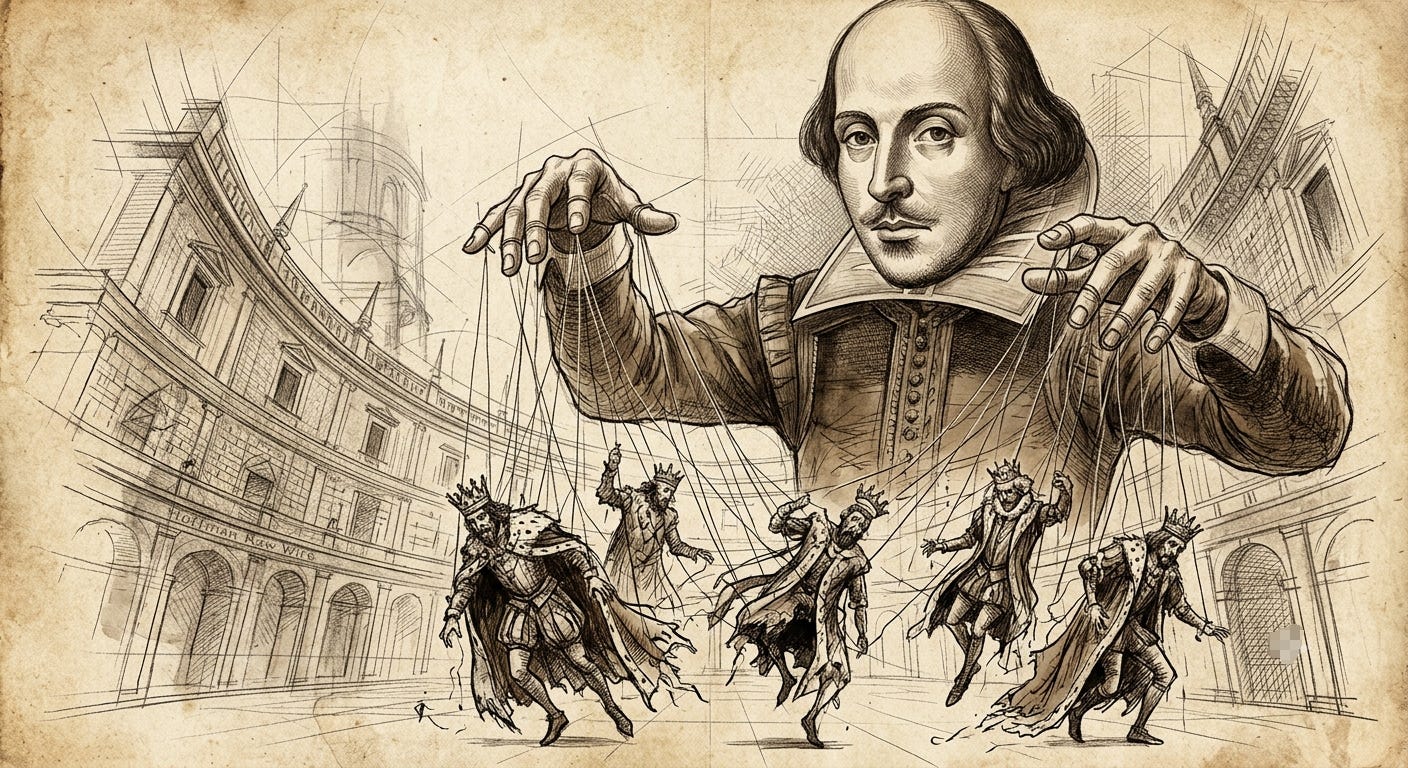
Every authoritarian regime relies on absolute control over what people see, think, and believe. Rulers insulate themselves with walls, laws, and weapons to hide a fragile psychological truth: behind the crowns and uniforms, they are driven by the exact same base impulses, madness, and paranoia as everyone else. But four centuries ago, William Shakespeare built a psychological trap that no tyrant could escape. Before psychology ever existed as a formal science, Shakespeare operated as the world’s first true clinical psychologist, mapping out the human mind with terrifying precision.
What made Shakespeare uniquely dangerous to the ruling class was his status as an absolute outsider. He possessed no noble blood, no university degree, and no political office. In an era where writers were treated as glorified servants dependent on aristocratic scraps, Shakespeare built a self-made commercial empire. He was a chief shareholder in his theater company and a part-owner of the Globe and Blackfriars theaters. This financial independence inverted the traditional power dynamic. He did not need to flatter the elite to survive; his wealth came from the masses.
When the nobility stepped into his theater, they were entering the domain of a civilian mogul who possessed a flawless grasp of their internal operating systems. He broke the monopoly on state narrative by proving that a commoner could read the minds of kings.
As the legendary Yale scholar Harold Bloom famously documented in his masterwork Shakespeare: The Invention of the Human, Shakespeare didn’t just write characters—he literally invented human personality as we recognize it today, showing characters capable of internal change, self-reflection, and psychological mutation by “overhearing” their own thoughts. His diagnostic precision was so absolute that when Sigmund Freud developed the foundations of psychoanalysis in the late 1800s, he kept Shakespeare’s volumes directly behind his desk, using Hamlet as the primary raw material to map the human unconscious and formulate the Oedipus complex.
Shakespeare did not write entertainment; he weaponized psychology to map the exact mechanics of power, greed, and behavioral manipulation. Below is the multi-century timeline showing how Shakespeare’s psychological mirror forced absolute rulers to reflect on their choices, caused historical leaders to question their own laws, and struck such immense fear into modern dictators that they had to ban his words entirely just to maintain control over the masses.
The Historical Blueprint of Subversion: Mapping the Fractured Minds of Rulers (1603–1941)
May 19, 1603 – The Patronage Pivot: King James I ascends the English throne and immediately takes control of Shakespeare’s theater troupe, renaming them The King’s Men. Rulers always seek to keep their profilers close. Between 1603 and 1616, the company performs at court over 150 times, completely outpacing all competitors.
December 26, 1604 – The Surveillance State Mirror: Shakespeare performs Measure for Measure at the court of Whitehall. The play features a ruler who disguises himself to secretly spy on his corrupt magistrates and citizens. Rulers in the audience are forced to watch a mirror of their own paranoia.
November 5, 1605 – The Terror Catalyst: The Gunpowder Plot is foiled. Catholic conspirators attempt to blow up King James, Parliament, and the entire legislative elite. The state responds with mass paranoia, witch-hunts, and public executions.
December 26, 1606 – The Psychological Trap: King Lear is performed before King James I at Whitehall. Following a year of state terror, Shakespeare presents a king who goes insane after tearing his own kingdom apart, exposing the fragility of absolute power directly to the man holding it.
April 1786 – The Founders’ Blueprint: John Adams and Thomas Jefferson visit Shakespeare’s birthplace in Stratford-upon-Avon together. Both future US presidents explicitly studied Shakespeare’s history plays (Richard III and Julius Caesar) not as theater, but as case studies on how political ambition degrades into British-style tyranny, using it to shape early American constitutional thought.
Paris, 1844 – Marx Decodes the God of Money: Philosopher Karl Marx writes his Economic and Philosophical Manuscripts. To explain how capital alters human behavior, he quotes Timon of Athens extensively. Marx uses Shakespeare’s description of gold making “black white, foul fair, wrong right” to prove that money is a “visible divinity” that completely inverts human nature and societal relationships.
Washington D.C., 1860s – Lincoln’s Wartime Mirror: President Abraham Lincoln carries a pocket copy of Macbeth throughout the American Civil War. Tormented by the bloodshed and his own sudden rise to power, Lincoln writes in private letters that he prefers the guilt-ridden soliloquies of Claudius and Macbeth over Hamlet. He used the plays as a psychological mirror to process the brutal burden of wartime governance and execution.
Moscow, Spring 1941 – Stalin Bans the Analytical Mind: Joseph Stalin attends a rehearsal of Hamlet at the Moscow Art Theatre and issues a quiet, offhand critique: “But Hamlet is weak.” The remark triggers a tacit 12-year moratorium on the play across the Soviet Union. Stalin, a master of behavioral control, feared a protagonist who scrutinizes his surroundings, separates state falsehood from truth, and acts independently.
Case Studies in Behavioral Decoding
I. Weaponizing Royal Paranoia
Rulers believe they control the masses through law, religion, and execution, but Shakespeare reversed the dynamic, placing the rulers under psychological surveillance.
To do this while avoiding the lethal blade of state censorship, Shakespeare deployed masterful strategic framing. He wrote highly charged political plays but set them safely in distant history or foreign lands. By setting Julius Caesar in ancient Rome or Macbeth in medieval Scotland, he gave the elite an exact mirror of their current power struggles without giving the Master of the Revels an explicit excuse to arrest him for treason.
Columbia University scholar James Shapiro, in his definitive study 1606: William Shakespeare and the Year of Lear, documents how Shakespeare explicitly used King James’s personal texts—Daemonologie (on witchcraft) and Basilicon Doron (on absolute rule)—to write Macbeth and King Lear. Shakespeare didn’t write fantasy; he extracted the king’s private fears, anxieties, and political vulnerabilities and staged them back to him. It was a terrifying psychological mirror showing the rot of tyranny and the inevitable madness and execution that follows an unlawful coup.
II. Stripping the Legislative and Religious Mask
Those who manufacture law and claim religious moral authority are frequently driven by the dark impulses they pretend to regulate. In Measure for Measure, the legislator Angelo enforces a law decreeing death for sexual immorality, only to immediately use his absolute legal power to extort a woman for sex.
Shakespeare explicitly used the stage to decode the hypocrisy of the governing elite, showing that absolute power attracts psychological corruption. He shattered the illusion of the “Divine Right of Kings”—the idea that rulers are chosen by God and answerable to no earthly law. By introducing deep, complex soliloquies, he turned theatrical monologues from mere plot devices into sophisticated philosophical and psychological x-rays. He showed kings being stripped of their crowns, losing their minds, and realizing that without their royal robes, a king is nothing more than a “bare, forked animal.”
III. The Economic Subversion: Gold Inverts Character
Rulers use currency to dictate behavior, but Karl Marx realized Shakespeare had already mapped out the psychological rot of monetization. In Timon of Athens, when a wealthy man loses everything, he realizes his friends only loved his gold.
Marx used this text to argue that money acts as a universal mediator—it allows a cowardly person to buy courage, or a corrupt legislator to buy justice, completely destroying authentic human character. Shakespeare decoded money not as a neutral tool of trade, but as a “visible divinity” that subverts human nature, alters behavioral baselines, and forces people to worship an illusion.
IV. The Dictator’s Fear of the Analytical Mind
The Soviet suppression of Hamlet is a pure study in authoritarian behavioral control. Under Stalin’s regime, art had to promote the collective state and unquestioning optimism.
A character like Hamlet—an isolated intellectual over-analyzing the corruption of the royal court—was viewed by Soviet authorities as a highly infectious psychological mirror that could inspire citizens to question the Kremlin’s directives. Stalin, a master of behavioral control, feared a protagonist who scrutinizes his surroundings, separates state falsehood from truth, and acts independently. The state did not fear the play because it was weak; they banned it because an analytical citizen is the ultimate threat to an authoritarian regime.
V. The Modern Mask: Why the Mirror Still Threatens the State
The battle between the profiler and the ruler did not end in 1941. Today’s governing classes, tech oligarchs, and legislative authorities have traded royal robes for tailored suits and media algorithms, but their internal operating systems remain completely unchanged. They still utilize massive public relations apparatuses to manufacture an illusion of absolute control, moral superiority, and intellectual dominance.
The core mechanics of control have simply shifted from theatrical stages to digital architecture. Where Shakespeare used the stage to profile the internal operating systems of the ruling elite, the modern state uses advanced data architecture, predictive algorithms, and behavioral profiling to turn the mirror back onto the masses. The absolute monopoly on human mapping has been weaponized by the institutional class to anticipate dissent, track psychological baseline alterations, and manufacture consensus at scale.
Shakespeare’s ultimate legacy was providing the blueprint to look past this institutional theater and dissect the raw human behavior underneath. The moment an individual stops listening to the official state script and begins analyzing the hidden motives, vulnerabilities, and psychological hypocrisies of those in charge, the power dynamic instantly shifts. Rulers still fear the mirror because it proves a universal baseline: no matter how high the throne, how advanced the tracking, or how absolute the authority, no one escapes their own psychology.