


For a long time, Zen has been sold in traditional Japanese packaging: black robes, wooden fish drums, manicured gravel gardens, and formal temple hierarchies. But when you strip away the cultural performance, it isn't a religion or a regional philosophy at all. It is functional architecture—the organic chemistry of consciousness. If you want to understand how awareness operates without getting bogged down in institutional dogma, you can stop looking at medieval commentaries and look directly at a living cell.
To understand this architecture, look at how a cell constructs physical reality. Deep inside the cytoplasm lies the ribosome: a high-speed molecular engine whose sole job is translation. Floating around it is an unstructured soup filled with raw components—twenty fundamental amino acids carried by transfer RNAs, mixed with endless chemical clutter. On their own, these floating components are static potential.
The ribosome is where that potential becomes form. It clamps onto the genetic sequence, creates a focused assembly site, and scans the surrounding environment. Out of millions of colliding molecules, it recognizes the exact amino acid required for that precise microsecond, pulls it inside, forms a peptide bond, and links it into a growing protein chain. Once bound, it steps forward and releases the past link. It does not hoard, debate, or delay. It translates raw code into physical life, moment by moment.
Awareness operates as the ribosome of consciousness.
The world around you is the surrounding cytoplasm—a vast, unmanifested pool of raw potential, sensory data, secondary thoughts, and environmental noise. When you bring focused attention to a moment, you instantiate the ribosome. Awareness reaches into the surrounding clutter, isolates the specific "amino acid" of immediate reality, and binds it into lived experience. What you pay attention to becomes the actual structure of your mind. Select the fundamental building blocks of direct perception, and you build clarity. Select reactive noise, social performance, or mental loops, and the structure collapses.
People often mistake this internal process for something "spiritual" or non-physical simply because a thought cannot be held in the hand. But consciousness is not a magical exception to the material world; it is governed by the exact same natural laws. The physical cell takes an unformed chemical soup, subjects it to precise selection, and outputs a physical protein. Internal awareness takes an unformed field of sensory noise, subjects it to focused attention, and outputs a concrete lived reality. It is not mysticism; it is the exact same translation engine operating at a different scale.
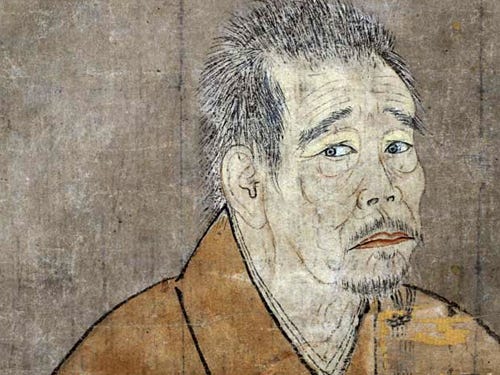
When fifteenth-century Zen master Ikkyū Sōjun abandoned temple hierarchies to walk the streets in worn-out clothes, he was engaged in this exact act of biological selection. He saw that elaborate rituals, fine robes, and official certificates were just non-essential junk floating in the cultural soup. He used pure awareness to strip them away, isolating only the essential building blocks of honest, unvarnished human reality.
Without active awareness, the truths of existence remain loose amino acids—pure potential doing zero work. The ribosome of your attention takes those chosen components, binds them instantly into direct action and behavior, and clears the site for the next sequence.
Wisdom is simply the complete decoding of this internal machinery. It means understanding both sides of the process: recognizing the unformed soup of existence outside, and mastering the active translation engine within.
Once you decode the sequence, the ultimate shift occurs: you release your grip. You realize the infinite environment outside runs itself, while awareness simply selects, binds, and releases. You identify the raw building block right in front of you, allow awareness to translate it into form, and step back. The mechanics of existence require no ceremonial costume or institutional permission. You observe the sequence, execute the selection, and let the rest of reality take care of itself.