


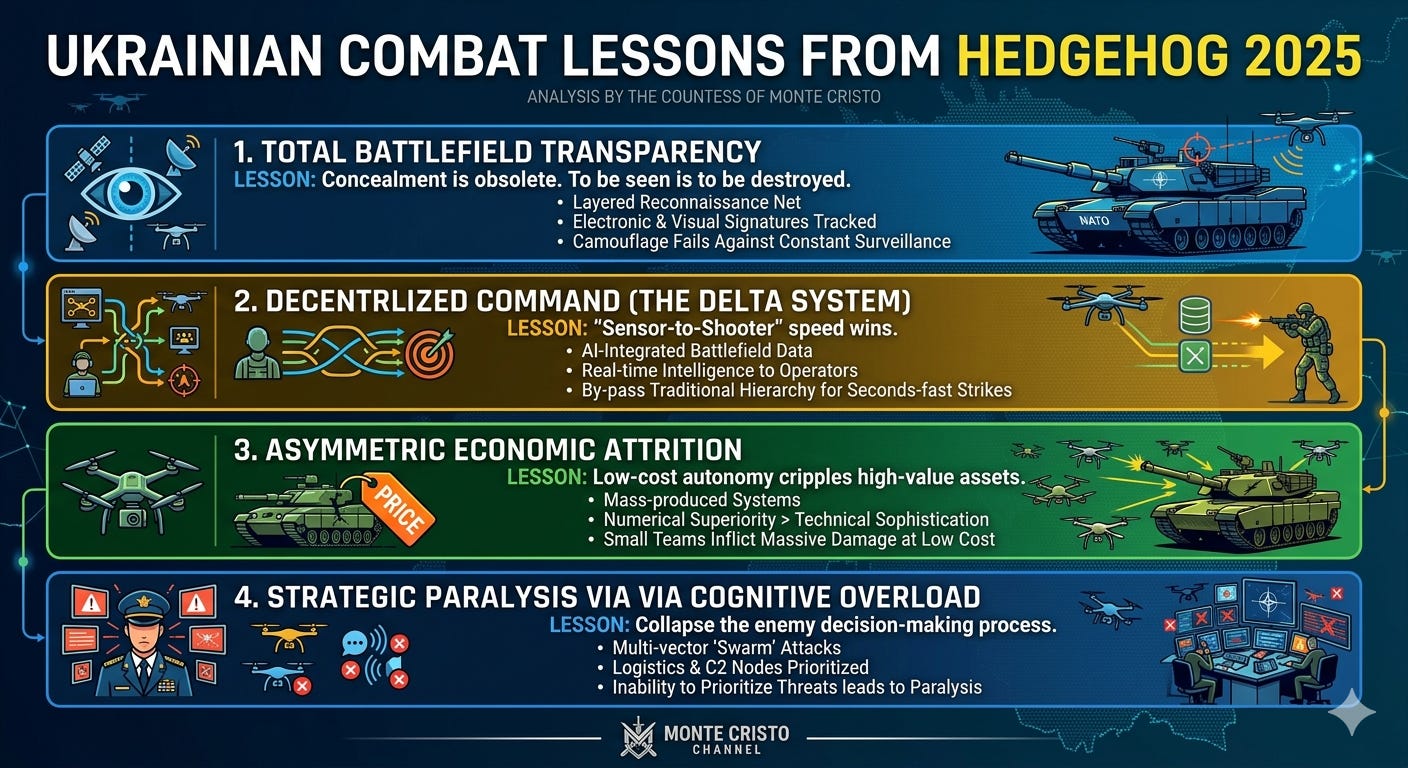
The Hedgehog 2025 exercises in Estonia served as more than a tactical drill; they functioned as a masterclass in modern attrition, conducted by Ukrainian operators for a NATO force still anchored in 20th-century doctrine.
The "Red Team" did not merely participate; they dismantled the opposition by applying four fundamental lessons forged in high-intensity conflict.
1. TOTAL BATTLEFIELD TRANSPARENCY
The Ukrainian team operated under the assumption that to be seen is to be destroyed. While NATO units relied on traditional camouflage and physical dispersion, Ukrainian operators utilized a layered reconnaissance net.
The Lesson: Physical distance is no longer a defense. If a unit emits an electronic signature or moves in daylight without active Electronic Warfare (EW) cover, its position is compromised within minutes.
2. DECENTRALIZED COMMAND (THE DELTA SYSTEM)
The most significant advantage demonstrated was the use of the Delta battlefield management system. This AI-integrated platform bypassed the traditional military hierarchy.
The Lesson: Success in modern warfare depends on "sensor-to-shooter" speed. By giving low-level operators the authority to strike based on real-time data, the Ukrainian team eliminated targets before NATO commanders could even process the initial contact reports.
3. ASYMMETRIC ECONOMIC ATTRITION
A core Ukrainian lesson taught during Hedgehog was the cost-efficiency of destruction. A 10-person drone team "eliminated" 17 armored vehicles—assets worth hundreds of millions of dollars—using equipment costing a fraction of that amount.
The Lesson: Mass-produced, low-cost autonomous systems can paralyze expensive, high-specification mechanized divisions. Numerical superiority in sensors and munitions outweighs technical sophistication in a single platform.
4. STRATEGIC PARALYSIS VIA COGNITIVE OVERLOAD
The Ukrainian forces utilized a "swarm" mentality, attacking NATO units from multiple vectors simultaneously—electronically, physically with FPV drones, and through constant surveillance.
The Lesson: The goal is not just physical destruction but the collapse of the enemy's decision-making process. NATO officers experienced "cognitive overload," becoming unable to prioritize threats as their command nodes and logistics hubs were systematically identified.