


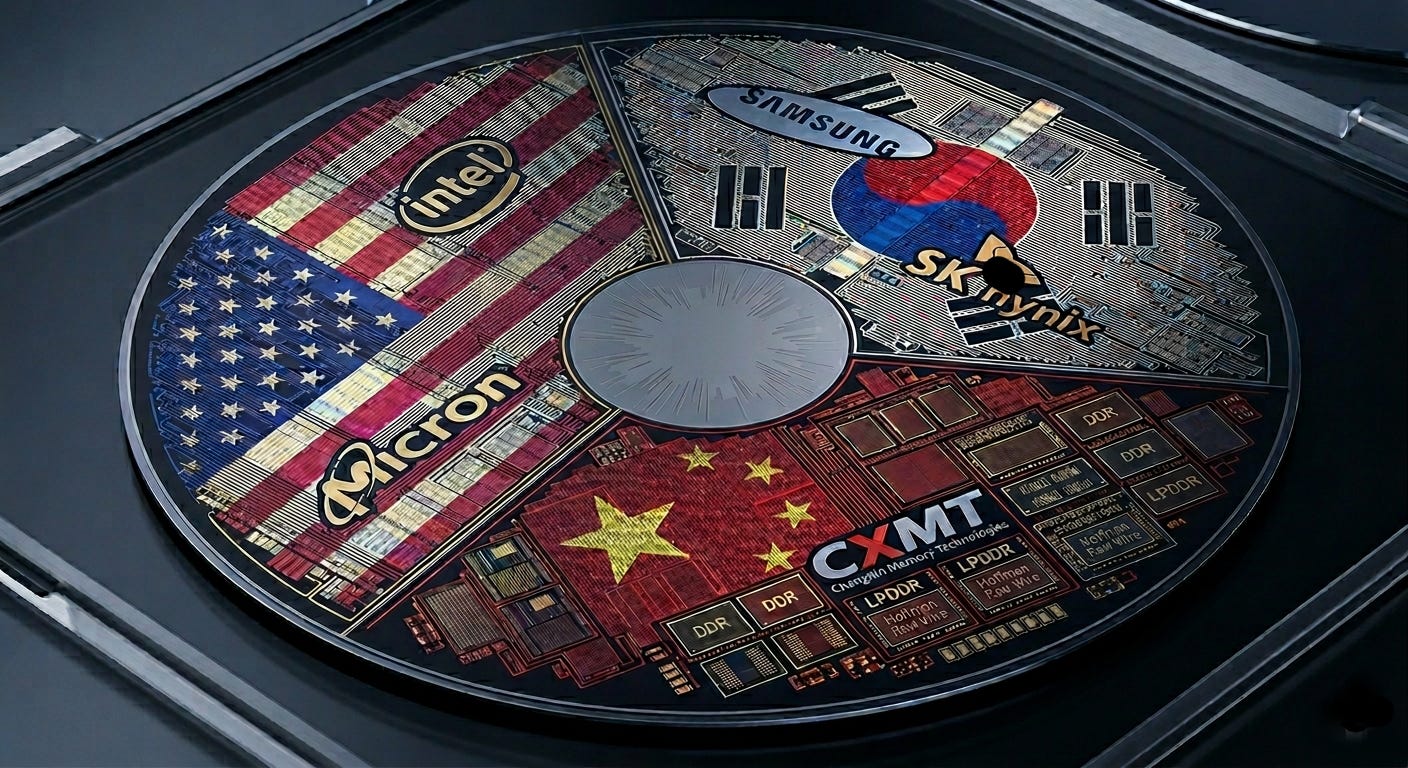
The modern global economy is hyper-focused on the choke points it can see. We track the flow of oil through the Strait of Hormuz, watch naval corridors, and obsess over Taiwan’s logic foundries. Yet, a far more devastating and concentrated economic flashpoint is being entirely ignored: the South Korean monopoly over high-end memory.
Without a rapid, wartime-footing intervention by a Western tag-team like Intel and Micron, the global tech economy is walking into a strategic debacle. By the end of this decade, the West could find its entire digital infrastructure held hostage without a single shot being fired.
The Cannibalization Supercycle
The current state of the global semiconductor market is not experiencing a standard cyclical fluctuation; it is undergoing a structural transformation. Driven by the insatiable demands of generative AI clusters, the Big Three memory fabricators—Samsung, SK Hynix, and Micron—have aggressively pivoted their factory lines away from standard computing memory to manufacture High Bandwidth Memory (HBM).
This pivot has triggered a brutal cannibalization effect across the broader technology industry. Manufacturing a single HBM wafer requires three to four times the raw silicon capacity of a conventional DDR5 wafer due to complex 3D stacking processes and lower initial manufacturing yields, which sit between 50% and 60%. Every wafer allocated to an HBM stack is effectively a wafer denied to consumer-grade memory production.
The resulting domestic shortages are stark. Data from TrendForce reveals that conventional DRAM contract prices experienced a staggering 93% to 98% surge in the first quarter of 2026 alone, with global industry revenue hitting 97 billion dollars. TrendForce data further indicates that AI could account for nearly 20% of global DRAM wafer equivalent consumption this year, a devastating allocation given that annual DRAM capacity growth is structurally constrained to just 10% to 15%. Recent market forecasts from Morgan Stanley indicate that this artificial scarcity will yield severe, unyielding deficits by 2027, leaving global PC DRAM supply 15% short of demand, and smartphone memory facing a 12% shortfall.
The Consumer Electronics Shockwave
The fallout of this AI infrastructure gold rush is no longer confined to server racks; it has spilled directly into the consumer economy, hitting consumer device prices with unprecedented inflation. Device manufacturers operate on paper-thin margins and are entirely unable to absorb these compounding component spikes. As a result, the cost of tablets, smartphones, and laptops is locked onto an aggressive upward trajectory.
Upstream component data outlines the scale of the crisis. Following the historic 93% to 98% first-quarter surge, TrendForce forecasts conventional DRAM contract prices to climb an additional 58% to 63% sequentially. Mobile memory used directly in phones and tablets has mirrored this disaster, jumping up to 93% quarter-over-quarter. Simultaneously, NAND flash memory—the foundational material for solid-state storage—has surged by 202% according to Gartner data. By the close of 2026, Gartner estimates an overall 130% explosion in combined DRAM and SSD wholesale costs. Memory components are projected to devour 23% of a laptop’s entire bill-of-materials cost, up from 16% last year.
This upstream inflation translates directly to a severe retail squeeze. Gartner forecasts that rising component costs will push retail PC and laptop prices up by an average of 17%, while average smartphone retail prices will spike by 13%. This pricing shock is already triggering a massive market contraction, forcing global PC shipments down by 10.4% and smartphone shipments down by 8.4% this year—the steepest hardware shipment contraction witnessed in over a decade.
The pain is hitting the entry-level tier hardest, creating a profound technological regression. In mobile markets, manufacturers are actively downgrading budget configurations, dropping standard entry-level phone specs from 12GB of RAM back down to a mere 6GB to prevent retail pricing from boiling over entirely. Xiaomi founder Lei Jun publicly labeled the current memory trend as crazy, warning consumers that the price rally is structurally insulated and will likely persist for at least two more years. Gartner analysts take the projection further, stating explicitly that the sub-500 dollar entry-level PC segment will completely disappear by 2028 as low-margin laptops become financially nonviable to manufacture. True pricing relief remains non-existent on the horizon, with Counterpoint and Gartner tracking late 2027 or early 2028 as the absolute earliest window for a potential supply plateau.
The Dangerous Geographical Illusion
The West has comforted itself with the passage of legislation like the U.S. CHIPS Act, believing that subsidizing local logic foundries solves the supply chain crisis. This is a severe miscalculation. You can build all the advanced AI processors and CPUs you want on Western soil, but if you do not have the high-speed memory stacks to place alongside them, the processors are nothing more than expensive paperweights.
The geographic concentration of this technology represents an extraordinary single point of failure:
The South Korean Duopoly: According to Counterpoint Research data for the first quarter of 2026, Samsung and SK Hynix collectively control 67.3% of the total global DRAM market (Samsung at 38.5%, SK Hynix at 28.8%). When narrowing the lens to premium High Bandwidth Memory (HBM), the concentration becomes downright terrifying: SK Hynix holds a massive 58% share of the HBM market, while Samsung commands 21%. Both conglomerates operate under the state-backed, family-controlled Chaebol system. Their entire manufacturing apparatus sits within range of conventional North Korean artillery and directly within the geopolitical crosshairs of East Asian maritime conflict.
The Micron Deficit: Micron stands as the lone U.S.-based manufacturer capable of producing advanced memory. Despite its technical excellence, Micron controls a stable but isolated 22.4% of the global DRAM market and a 21% share of the premium HBM supply. Despite increasing its capital expenditure to a massive 20 billion dollars to address the crisis, Micron has explicitly reported that its entire HBM supply is completely sold out. Even if every grain of Micron’s domestic silicon remained in North America, it lacks the sheer baseline capacity to sustain the Western economy during a supply disruption. It cannot even supply the baseline computing needs of the United States alone.
Optimists point to Micron’s aggressive domestic footprint as the ultimate savior. The company broke ground on its massive 100 billion dollar semiconductor complex in Clay, New York, and recently finalized the selection of Bechtel to spearhead the engineering, procurement, and construction for the site’s first phase. Combined with its multi-billion dollar expansion in Boise, Idaho, Micron is executing the largest private investment in New York State history.
Yet, this massive infrastructure push highlights a fatal timeline mismatch. Cleanrooms cannot be built overnight. Micron’s first Idaho fab is not scheduled for initial DRAM wafer output until mid-2027, the second Idaho facility drops closer to late 2028, and the sprawling New York megafab will not achieve scaled mass production until the turn of the decade. This leaves a critical, unhedged four-year strategic vacuum between now and 2030. Intel remains the only domestic entity with pre-existing, advanced cleanroom real estate that could be retooled rapidly enough to act as an emergency bridge.
The 2030 Containment Window
While Western firms chase near-term quarterly profits, Beijing is playing a long-term game of asymmetrical attrition. China’s national memory champion, ChangXin Memory Technologies (CXMT), has quietly captured 8.0% of the global DRAM market, climbing rapidly from just 3% a year ago. They are scaling up production lines to absorb the lower-margin legacy memory supply abandoned by the West.
This targeted capture of legacy and standard consumer DRAM nodes is an intentional trap. As South Korean and U.S. fabs completely abandon standard memory lines to chase high-margin HBM allocations, CXMT is steadily securing a silent monopoly over the foundational silicon components that run Western critical infrastructure. The standard, low-margin DDR memory chips that route defense radar networks, medical imaging equipment, and automotive computing architectures are increasingly being sourced directly from state-backed Chinese lines.
Currently, China is hitting a structural wall. Strict export controls legally bar the Dutch lithography monopoly ASML from shipping its cutting-edge Extreme Ultraviolet (EUV) systems to Chinese soil. Without these machines, Chinese engineers are trapped in an incredibly complex, multi-year trial-and-error cycle—relying on older Deep Ultraviolet (DUV) machines and brute-force multi-patterning workarounds that ruin factory yields and inflate costs.
Geopolitical analysts widely point to a critical timeline: 2030. By the turn of the decade, China’s domestic engineering workarounds are projected to mature, or regional strategic objectives regarding Taiwan and the South China Sea may reach a boiling point.
If Beijing chooses to weaponize its position—or threatens a maritime blockade that isolates South Korea’s ports—they will effectively control the flow of the global digital economy. The Islamic Revolutionary Guard Corps (IRGC) can disrupt global commerce by threatening ships in the physical chokepoint of Hormuz; a parallel economic freeze can be executed in the silicon market without firing a single kinetic round. A simple threat to halt exports or sever regional shipping lanes would cause global tech supply chains to collapse overnight.
The Strategic Mandate: A Forced Alliance
The West cannot afford to wait out the current shortage, nor can it gamble on a volatile 2030 geopolitical horizon. Cleanroom fabrication facilities require three to four years to build, tool, and qualify. If a domestic memory hedge is not initiated immediately, the West will remain entirely exposed when the window closes.
The solution requires breaking down traditional corporate walls. Intel and Micron must form a strategic manufacturing alliance:
Intel’s Asset Contributions: Intel possesses the domestic, cutting-edge cleanroom real estate, advanced automated logistics, and a massive lead in advanced 3D silicon packaging infrastructure.
Micron’s Asset Contributions: Micron holds the vital, proprietary architectural intellectual property for high-density DRAM and HBM layouts that Intel lacks.
By combining forces—whether through joint venture factories or dedicated foundry licensing agreements—Intel could pivot a portion of its upcoming domestic fab capacity to manufacture Micron-designed memory architectures. This would instantly accelerate Western self-reliance, bypass the years-long backlog of ordering new lithography tools from ASML, and establish a secure, geographically protected supply of both logic and memory.
If Western policymakers and corporate boards do not wake up to this vulnerability immediately, they will eventually face a supply chain debacle that no amount of emergency legislation can fix. National security requires silicon sovereignty—and true sovereignty is impossible when your entire digital economy relies on a single, vulnerable peninsula.