

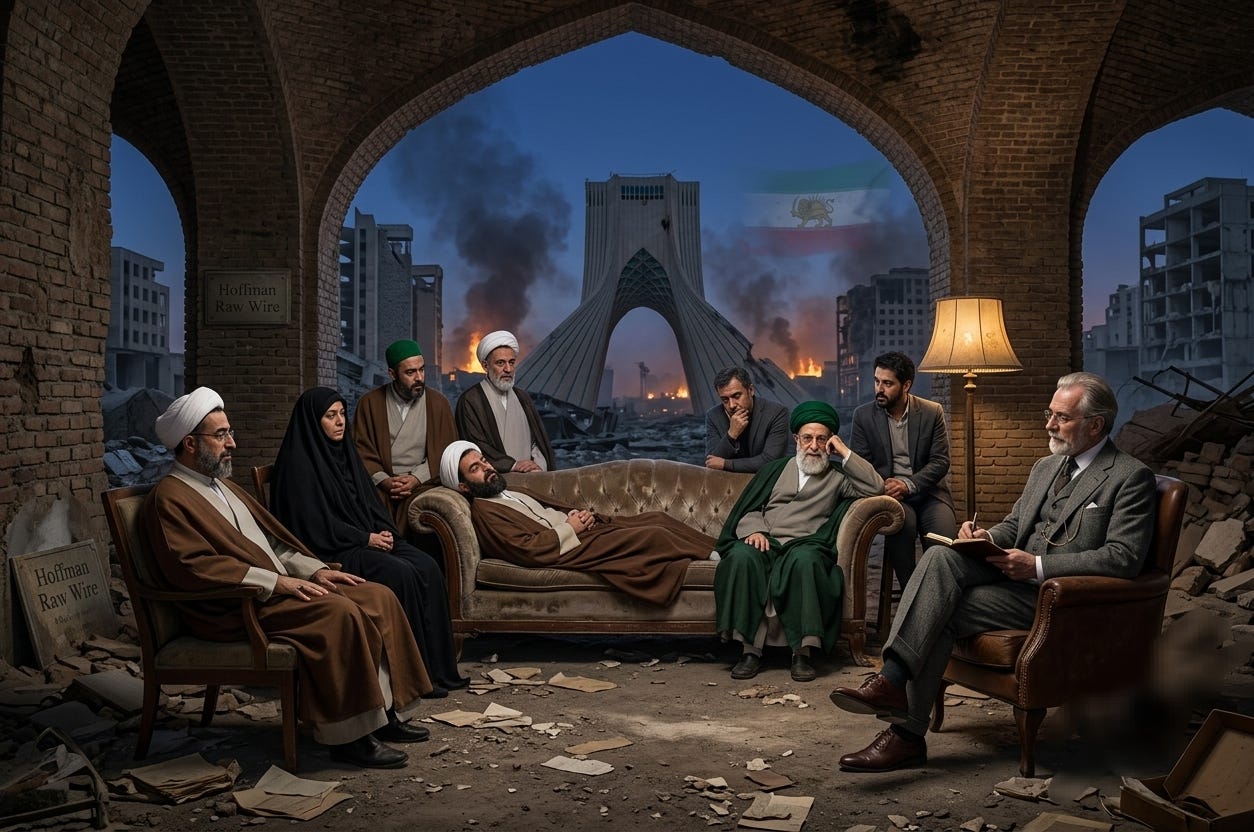
In standard psychiatry, a manic episode is not just "eccentric behavior"; it is a distinct, measurable period of abnormally elevated, expansive, or irritable mood paired with a massive spike in goal-directed energy. According to the diagnostic framework, a true manic state requires three core pillars: grandiosity (inflated self-esteem), an increase in high-intensity goal-directed activity, and an absolute disregard for catastrophic consequences.
When we place the Islamic Revolutionary Guard Corps (IRGC) on the geopolitical couch, the diagnosis fits perfectly. For decades, the IRGC operated in a state of high-stress calculation, managing internal infrastructure decay with cautious external posturing. However, following the psychological and physical shocks of recent military campaigns, the leadership shifted from calculating survivalist to clinically manic. The regime is currently acting out a textbook case of systemic psychosis—exhibiting intense grandiosity, unhinged risk-taking, and rapid-fire demands that completely ignore its near-fatal internal realities.
1. Timeline of the Escalation: From Depressive Stagnation to Mania
The Baseline State — Severe Vulnerability (Pre-June 2025): Before the conflict, Iran was trapped in an economic and environmental crisis. Decades of IRGC mismanagement had depleted the country’s water tables, leaving over 300 cities in critical water stress. Major dams hit historically low levels, triggering civilian water riots in Khuzestan and Isfahan. Tightened international sanctions cut off the capital required to fix failing infrastructure.
The Inhibited Phase (Strategic Restraint): While under these severe domestic pressures, the IRGC exhibited rational inhibition. They kept the Strait of Hormuz open and avoided direct, overt provocations against superior military powers, knowing that a major maritime disruption would trigger a Western response their hollowed-out economy could not survive.
The Acute Shock — The 12-Day War (June 13–24, 2025): Believing the IRGC was too paralyzed by domestic unrest to retaliate, Israel launched Operation Rising Lion on June 13, 2025, decimating command structures. On June 22, 2025, the United States directly intervened with Operation Midnight Hammer, deploying B-2 Spirit bombers to drop GBU-57 Bunker Busters on underground nuclear enrichment sites at Fordow, Natanz, and Isfahan.
The Psychological Break (February 28, 2026): The regime's remaining reality-grounding shattered when a joint US-Israeli daylight airstrike successfully assassinated Supreme Leader Ali Khamenei at his compound in Tehran, thrusting the clerical regime into existential panic and triggering the current manic shift.
2. Clinical Indicator: Unprecedented Risk-Taking, Grandiosity, and Stripping the Regional Masquerade
A defining symptom of mania is "excessive involvement in activities that have a high potential for painful consequences." The IRGC’s actions in early 2026 violate all conventional statecraft logic for a nation facing internal bankruptcy, marked by highly sophisticated psychological maneuvers designed to force a complete collapse of regional duplicity.
The Audacity of Unit 4000 and the Turkish Paradox: Operating out of pure strategic erraticism, the IRGC's Unit 4000 (the Special Operations Department), led by Rahman Moghaddam and operative Mehdi Yekeh-Dehghan, established deep espionage cells. They smuggled explosive suicide drones through Turkey into Cyprus, executing strikes against the British Royal Air Force (RAF) base at Akrotiri and actively targeting US installations like Incirlik Air Base in Turkey.
By executing these kinetic strikes and operations inside Turkey, the IRGC violently exposed Ankara's dual nature. Turkey’s leadership has consistently utilized the most severe regional rhetoric against Israel, positioning itself as the ultimate defender of the regional status quo. Yet, beneath this public defiance, Turkey remains firmly anchored as a critical ally and friend of the Trump administration, maintaining vital structural and logistical channels. The IRGC forcefully highlighted this gap—proving that Ankara's fierce ideological posturing is fundamentally constrained by its pragmatic Western dependencies.
The UAE Conundrum and the Financial Lifeline: Concurrently, the IRGC demanded extreme, unworkable terms regarding its terror assets in Lebanon, preferring to let a fragile ceasefire dissolve completely rather than adjust to their compromised military reality. They backed these demands by physically launching strikes against the UAE, targeting their own critical economic clearing house.
The United Arab Emirates has long functioned as the premier hub for global cash, gold, and rapid capital clearance in the Gulf. For years, the IRGC’s financial networks and front companies were deeply dependent on the UAE’s financial architecture to launder proceeds and bypass crushing Western blockades. Yet, the UAE simultaneously maintains formal, deep-seated diplomatic and intelligence relations with Israel.
The Sweet Spot: The IRGC struck its own financial lifeline not out of tactical error, but to force a raw exposure of this exact duplicity. The message was clear: the regime would rather choke its own economic clearing house than tolerate a neighbor that attempts to run a massive sanctions-evasion machine for Tehran while harboring open relations with its primary adversary. The strikes successfully forced the UAE into an agonizing corner, demonstrating that in the IRGC's manic calculus, absolute ideological alignment overrides mutual economic survival.
3. Historical Parallel: The 20th Century Analogy
The closest historical parallel to an economically hollowed-out state experiencing a sudden manic strategic shift is Imperial Japan in late 1941.
Like the IRGC, Imperial Japan faced economic strangulation due to Western oil embargos and lacked the long-term resource surplus to fight a global superpower. Rather than backed into a corner and capitulating, Tokyo’s leadership experienced a manic ideological pivot—convinced of their spiritual invincibility and gripped by grand delusions of bringing the Western dragon to its knees. This resulted in the hyper-audacious gamble of attacking Pearl Harbor, choosing a high-risk offensive path toward self-destruction over realistic internal compromise.
4. Squeezing the Lemon: The Islamabad MoU and Flight of Ideas
In a manic state, the subject often misinterprets boundaries, viewing a counterparty's patience or desire for peace as a validation of their own grandiosity:
The Islamabad Memorandum of Understanding (MoU): Signed on June 17, 2026, through Pakistani mediation, this interim deal between President Donald Trump and Iranian President Masoud Pezeshkian establishes a 60-day ceasefire extension. It dictates the reopening of the Strait of Hormuz to commercial shipping, the removal of the US naval blockade within 30 days, and a proposed $300 billion Western-backed economic reconstruction fund.
The Manic Read: Military experts warn that the IRGC is misreading Trump’s eagerness for a rapid diplomatic exit as weakness. Instead of using the 60 days to de-escalate, the IRGC is actively trying to "squeeze the lemon." Despite signing the MoU, they have spent the last 48 hours testing boundaries by launching drone provocations in maritime transit zones—using the 60-day window to bypass the blockade and secure massive financial frameworks without altering their underlying nuclear goals.
5. The Core Conclusion and The Forced Dependency on China
The Proliferation Loop: Because a manic state lacks internal regulation, the IRGC will not slow down. They will accelerate their pursuit of a nuclear breakout as an ultimate regime-survival guarantee. This unhinged behavior will inevitably force the hyper-wealthy Gulf States, such as Saudi Arabia and the UAE, to rapidly acquire or build their own nuclear deterrents to maintain regional parity.
The Chinese Strategic Foothold: The ultimate tragedy of this systemic madness is that by isolating itself entirely from Western economic systems, the IRGC has systematically eliminated its own alternatives. European and Western states would have been entirely willing to step in and finance portions of the rebuilding effort if normal diplomatic channels existed, but that reality is now obsolete. Even if elements within the IRGC resist ceding sovereignty to Beijing and fundamentally distrust Chinese motives, necessity has completely overridden sentiment. The regime has no other viable choice; it is forced into absolute reliance on China, as Beijing remains the only global actor willing and able to purchase Iranian oil under heavy restrictions.
Furthermore, China possesses the exact materials, infrastructure capacity, deep manpower reserves, and advanced technology required to rebuild Iran’s ruined domestic grids and military apparatus. The IRGC has ultimately sold its soul to the Chinese Red Dragon, presenting a catastrophic, long-term strategic loss for Western states that are now entirely removed from the theater of competition. This marks the second major prize Beijing has secured on the global chessboard without firing a single shot. Having already absorbed Russia into its economic and strategic orbit, China is now effectively taking control of the IRGC and the wider Iranian apparatus.