


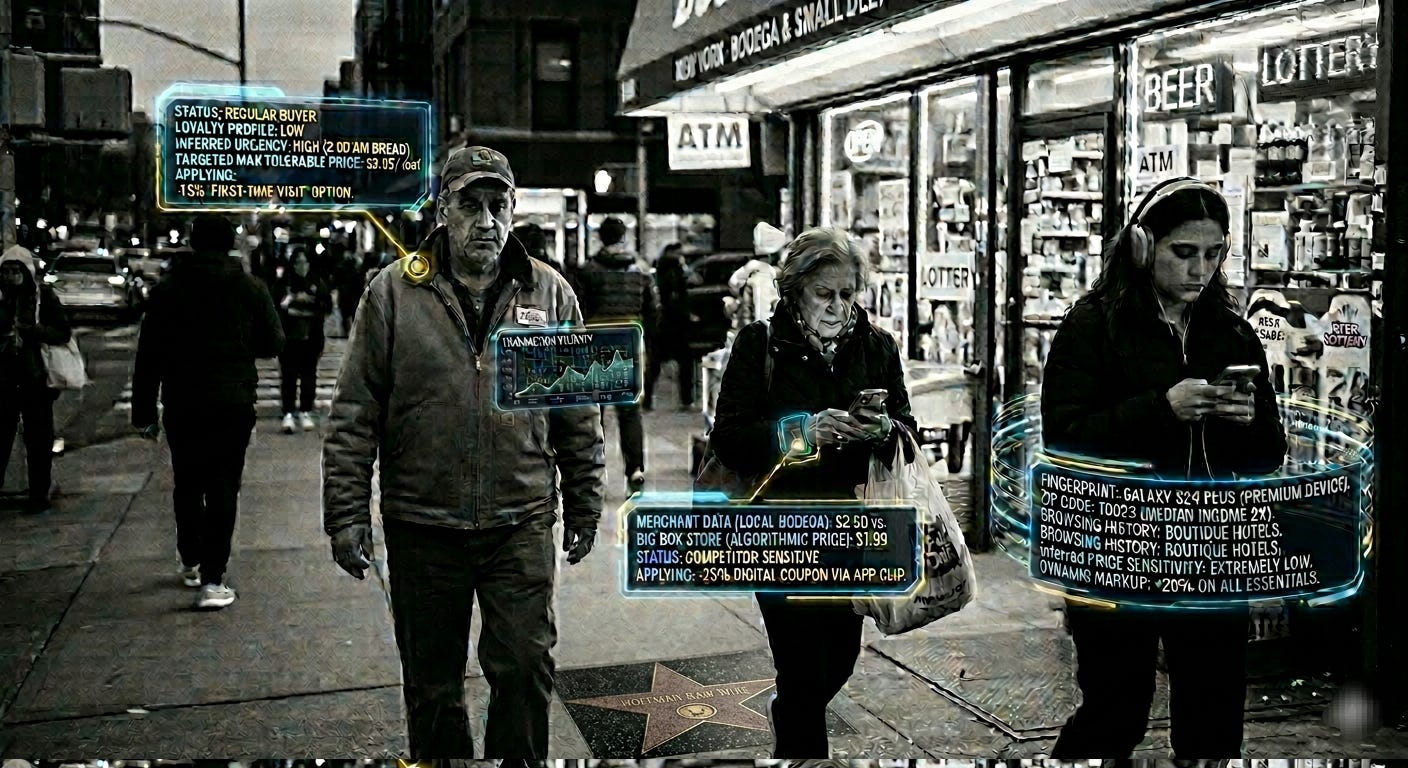
Welcome to the cutting edge of retail innovation, where the simple act of buying a loaf of bread now requires the computational power of a ballistic missile defense system.
For decades, the standard rules of commerce were painfully primitive. A business set a price based on supply, demand, and overhead. If you walked into a local bodega in the Bronx, a burrito or a bag of chips cost a fraction of what it did in a boutique market in Manhattan. It was an economy rooted in geography, physical reality, and basic fairness.
But traditional economics are entirely too transparent for the modern corporate apparatus. Enter Surveillance Pricing—the corporate elite’s latest gift to humanity.
Why charge a fixed, honest price when an artificial intelligence platform can track your online behavior, location, and device hardware to calculate the exact maximum amount of financial pain you can tolerate in real-time?
The Philanthropy of the Price Hike
To appreciate the sheer psychological audacity of this ecosystem, one must first look at the vocabulary. Corporations do not engage in "price gouging" or "behavioral exploitation." Instead, corporate public relations firms have seamlessly rebranded this digital asset strip as "Personalized Rewards" and "Hyper-Customized Offers."
The corporate narrative is deeply touching: these algorithms are staying up all night, chewing through petabytes of data, simply to save you money.
The actual mechanism is far more sinister. Retailers utilize third-party intermediaries—AI pricing engines like Revionics, Bloomreach, and PROS, backed by data from financial consulting giants like Mastercard—to artificially inflate the baseline price of a product across the board. They then selectively walk the price back down via digital coupons, but only for the specific consumers their data models flag as high flight risks.
If you are a loyal, stable customer who repeatedly buys the same product, the algorithm recognizes your low price sensitivity and hits you with the maximum baseline cost. You are effectively penalized for your loyalty. It is a system that has successfully transformed price discrimination into a celebrated loyalty perk.
The Illusion of Compliance: The All-Caps Shield
As state regulators scramble to catch up, the corporate workaround highlights the utter futility of current consumer protection laws. Consider New York’s recent legislative attempts to mandate algorithmic transparency by requiring prominent disclosures if personal data is used to manipulate pricing.
The corporate compliance solution is a masterclass in passive-aggressive bureaucracy. Go to a digital checkout screen today, and you will find a tiny, block-text disclosure buried at the absolute bottom of the page:
NOTICE: THIS PRICE WAS AUTOMATICALLY CALCULATED BY AN AI ALGORITHM UTILIZING YOUR BEHAVIORAL PROFILE, DEVICE CONFIGURATION, AND INFERRED PURCHASING URGENCY.
They know with absolute certainty that modern consumers have been conditioned by decades of software agreements to ignore the fine print. By slapping an all-caps warning where no one looks, the disclosure becomes a legal shield. When the system extracts an extra premium from your wallet, the corporation can legally throw its hands up and say, "We told you we were tracking your battery percentage and zip code to adjust the price, but you clicked 'Accept' anyway."
The Digital Bulldozer for Mom-and-Pop Storefronts
While consumers are nickel-and-dimed on their screens, the true devastation of this system takes place on the pavement of our major cities. Independent brick-and-mortar storefronts—the neighborhood bodegas, delis, and family-owned markets—are being systematically priced out of existence because they commit the ultimate corporate sin: charging the same price to everyone.
Federal Trade Commission (FTC) data highlights an insurmountable technological divide. Corporate entities plugging into automated pricing platforms report a systematic revenue growth of 2% to 5% purely from automated price fluidness. A small, independent shop operates on razor-thin margins and possesses neither the millions of dollars required to purchase these predictive systems nor the billions of data points needed to train them. While a corporate chain pharmacy dynamically squeezes profit out of a customer based on their digital footprint, the local shop is stuck using a static pricing gun.
Furthermore, independent urban stores are increasingly forced to use third-party delivery applications just to reach their neighborhood customer base. When a local deli lists an item on these apps, the platform controls the digital interface. The platform's algorithm can instantly inflate the final checkout total of a local store's item by over 20% based on the user's location or inferred urgency. The customer blames the small, local merchant for the exorbitant price, while the delivery platform pockets the dynamic service fees.
This predatory architecture completely bypasses traditional antitrust protections like the Robinson-Patman Act. Corporate giants no longer need to fight for cheaper inventory on the wholesale back end; they simply use behavioral surveillance to maximize profit margins on the front end. They can temporarily drop prices to an un-competitive low in a specific zip code to starve out a local independent competitor, while instantly subsidizing those losses by hiking prices for captive online shoppers elsewhere.
The Final Transaction
This leaves the independent merchant with a catastrophic Catch-22: keep prices transparent and static, thereby appearing "too expensive" compared to a big-box store's algorithmic "personalized discount," or attempt to implement a tracking system of their own, completely alienating the neighborhood base that relies on them for cash transactions and basic privacy.
We have arrived at a spectacular economic destination. To avoid paying the maximum, artificially inflated baseline price for basic consumer goods, you are forced to download a tracker, scan a digital clip, and surrender your location data, device metrics, and purchasing habits.
The software vendor then takes that harvested data, packages it, and feeds it right back into the pricing machine to determine exactly how much more to charge you on your next visit.
You are no longer just paying with currency. In the modern corporate ecosystem, you are forced to buy back a fair price using the very data they will use to exploit you tomorrow.